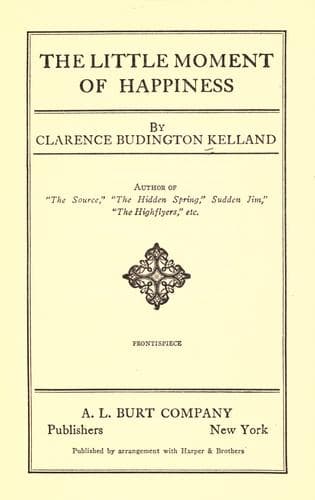
The Little Moment of HappinessKelland, Clarence Budington
General
The Little Moment of Happiness
Kelland, Clarence Budington
Man-woman relationships -- Fiction; World War, 1914-1918 -- Fiction
Ken heard this prophecy early in the morning, and it troubled him. He
had no cause for imagining that he would be selected, yet he might be
selected. The chances were, perhaps, minute, but, nevertheless, they
were present, and it was far from his desire to be returned to America
to run down German sympathizers in Hoboken or to take a desk in some
crowded bureau in Washington. While he was in France there always was
the hope that he might be transferred to active duty with some regiment
at the front. Like all men in the American Expeditionary Force, he
wanted to serve at the front, and he did not want to return to
America—at least until the work was done. Man after man Kendall had
heard to speak longingly of America, but to couple with his homesickness
the quick statement that he did not want to return until the job was
done. It was a sort of religion—the cleaning up of that job. Somehow
each man seemed to feel that the success of the army depended on his
presence, and that to be sent home before victory arrived would be to
deprive him of something precious which he had earned.... It was so with
Ken.
But he had a stronger motive than most for wishing to stay in France. It
was Andree....
Suddenly and very poignantly he realized what it would mean if he were
compelled to part from Andree. It seemed to him that she had become a
part of him, an essential part without which he could not continue. She
had brought an essence into his life which was sweet and desirable and
wonderful. He knew that no other woman could bring to him what Andree
had brought so unconsciously, yet so generously.... She was Andree!...
Andree! The world could show but one.
What was to be the outcome? It was a question he had evaded time and
again, well knowing that it must some day be faced. He did not face it
now, though it urged itself upon his attention. He did not believe the
world had seen a more precious thing than their love—and yet, because of
his training and the imprint of heredity, that love was questionable,
tainted with irregularity. It was good, sweet, pure, but it was
irregular as the Middle West and Plymouth Rock perceived irregularity.
He had never known Andree to utter an immodest word or to think a
thought that was not clean and good. He had wondered at a certain
diffident loftiness in her thoughts. She was a woman whose soul was to
be regarded with awe, as any virtuous soul is to be regarded with awe.
He did not believe he saw her falsely, nor that love blinded him to
defects which should be apparent. He knew he saw her truly, and that she
was worthy of all his love.... And yet his friends, his neighbors—above
all, his mother—would despise her as a woman of light virtue, as a thing
of evil.... He could see the seething among the gossips if Andree were
to be set down in their midst, and he despised them.... But—
Public-domain text, read in full here on John Shaqi.
Reviews
Reviews
No reviews yet
Be the first to share your thoughts on this work.
Elsewhere in the archive
Join the Discussion
Join the discussion
Sign in to leave a comment or review.
Sign InorCreate an account