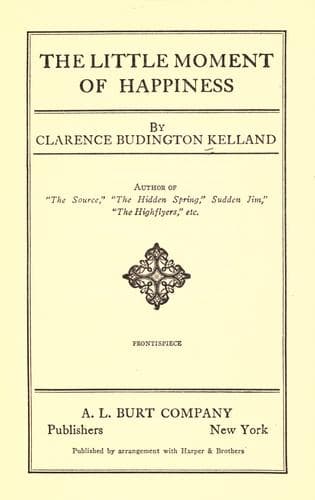
The Little Moment of HappinessKelland, Clarence Budington
General
The Little Moment of Happiness
Kelland, Clarence Budington
Man-woman relationships -- Fiction; World War, 1914-1918 -- Fiction
Again he evaded. He had not the courage to ask himself what he would do
when the moment for doing arrived.... He could not give her up. That was
the thought that came now—that she was indispensable.... But would he
have the courage to face the vestibule of the Presbyterian church with
her? He did not ask.
One of those moods of depression to which he was liable when his
reflections were troubled settled upon him. He was acutely unhappy.
Those moods possessed a physical sensation, not a pain so much as a
consciousness of the existence of his body, which was very disturbing.
It was as if his arms and legs had suddenly become vivid. At such times
he did not want companionship, could not have answered conversational
advances. The life within him seemed to become as putty—a dead mass. The
only relief was to walk and walk and walk.
He left the office to trudge to the apartment, meaning to eat lightly
and to wander about Paris until the obsession was ejected.... At the
entrance to the building the concierge was standing, waiting for him.
“Oh, monsieur ... monsieur,” she said, and broke forth into weeping.
He was not surprised. Such scenes were to be expected in those days when
every mail brought word that some loved one had been demanded of his
country. He patted her shoulder awkwardly.
“You have had evil news, madame,” he said. “I am so sorry.”
Through her tears rage flared. “The _boches_,” she exclaimed. “Why is it
that the good God allows such creatures to be!... What good can it do
them? But they would laugh and be joyous. It is so. I have read....
These killers of babies!”
“What is it, madame? Your son? Have you had the news?”
“My son, monsieur, is gone these two years,” she said, not without a
lift of the shoulders. “It would not be that. When one is a soldier one
must march.... To kill the men—that is war. But the babies—the helpless
little babies!... They are not men, monsieur, but monsters....”
“Yes.... Yes,” he answered, not knowing what to say.
“And monsieur loved her, did he not? It was Arlette who declared it to
be so. Always she spoke of the fondness of monsieur for the _petite
fille_—the tiny Arlette.”
“Little Arlette! What do you mean, madame? What has happened to little
Arlette?”
“_La longue portée, monsieur._ Again it began to fire this day. It is
that you have heard its explosions.... This Big Bertha of the boche that
murders babies!... _La pauvre enfant!_ She is playing in the street
before her home. Out of the sky comes the shell of this so wicked
cannon. There is a noise of great frightfulness.” She covered her eyes.
“When the smoke makes to lift itself and one can see—there lies little
Arlette....”
“Killed!” Kendall felt something that was rage and grief clutch his
throat. “Have they killed that child?”
Public-domain text, read in full here on John Shaqi.
Reviews
Reviews
No reviews yet
Be the first to share your thoughts on this work.
Elsewhere in the archive
Join the Discussion
Join the discussion
Sign in to leave a comment or review.
Sign InorCreate an account