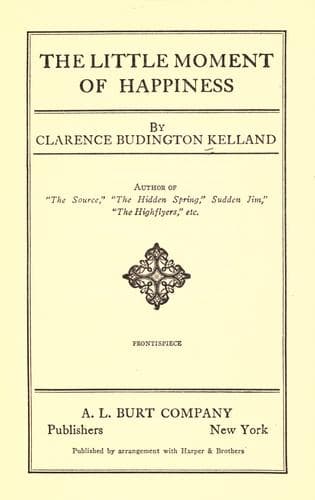
The Little Moment of HappinessKelland, Clarence Budington
General
The Little Moment of Happiness
Kelland, Clarence Budington
Man-woman relationships -- Fiction; World War, 1914-1918 -- Fiction
“What do you mean?”
“I mean, what has seeing and feeling done to you? Has it made any
permanent changes in you? Your experiences here have impressed you a
great deal—but how long will the effect last when you get home?... When
Paris is just a memory—and a subject for conversation? In ten years will
you be any different as a result of all this than you would have been if
you had never come?”
He hesitated. “I don’t know,” he said, slowly. “What do _you_ think?”
“I think,” she said, “that we will get back into the old environments
and the old habits and will become just what we would have been. If we
were to stay here, then we might change, broaden, really profit by our
experiences. But we go home. We see the same faces, hear the same sort
of talk, and are tied by the same sort of prejudices and theories and
narrownesses that we used to accept without question. We will know
better for a while, and then we will revert.... It takes something
pretty big and startling to change a person forever.”
“Big and startling.... You mean something in his own life and
experience—something personal to him—that is big and startling?”
“Yes.”
“Like—”
“Oh, like committing a crime, or making some supreme decision or
sacrifice.... Anything that strains the very soul of a person so that it
can never get back into its former shape.”
“Love?”
“Not love itself, but something wonderful or terrible that comes as the
result of a love.”
“Then you don’t think experiences change people, that it is—well, just
making decisions that grow out of the experiences. It is reaching a
crisis and then making a choice of which way you will go.”
“I think that is it. I don’t see how any event can change a person if he
remains merely a spectator. I don’t think any sort of happening will
really alter a person for good and all unless it has compelled him to
use every bit of his will and courage and intelligence to make up his
mind what he will do about it. If he chooses the right way, then he
becomes stronger; if he chooses the wrong way or dodges the decision, he
becomes weaker.”
“There’s no dodging the choice,” he said.
“And that is what’s the matter with you, isn’t it?”
“Yes.”
“And the choice?” She knew very well what problem he was laboring over.
“Is Andree,” he said.
“She was bound to be the problem. Couldn’t you see that from the
beginning?”
“That doesn’t matter now—what I saw at the beginning. All that has
happened has happened”—he paused and stared down at the table-cloth—“and
I’m glad it did happen.... But now I’ve got to settle the bill.”
“And you want my advice?” She looked at him queerly. “You have come to
_me_ for advice about this?”
“Not for advice. I just want to know what you think.”
“About what—definitely?”
“Whether I should marry Andree?”
“Why shouldn’t you?”
Public-domain text, read in full here on John Shaqi.
Reviews
Reviews
No reviews yet
Be the first to share your thoughts on this work.
Elsewhere in the archive
Join the Discussion
Join the discussion
Sign in to leave a comment or review.
Sign InorCreate an account