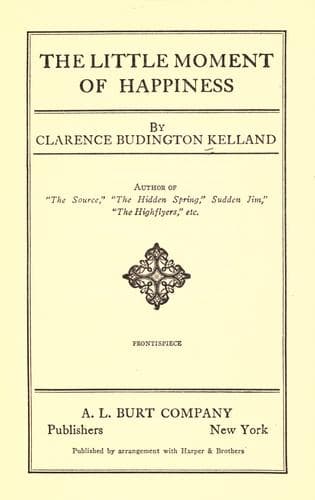
The Little Moment of HappinessKelland, Clarence Budington
General
The Little Moment of Happiness
Kelland, Clarence Budington
Man-woman relationships -- Fiction; World War, 1914-1918 -- Fiction
“It isn’t sentimentality, at any rate.... And nobody can ever convince
me that I’ve done wrong or that I’ve taken any harm from her.... Even if
this should prove to be only an episode, it has been a beautiful episode
with nothing but good in it.... But this mystery, this fairy element,
has somehow kept the realities at a distance. I have simply gone along
and _lived_.... Why, I have hardly thought of such a thing as marriage
in connection with her. Possibly you won’t understand that, but I
understand it perfectly.... To marry Andree would be to make her real,
material. The mystery would be gone.”
“I think I understand.”
“But to marry her and take her to Detroit!... Suppose I should take her
home and then this story should come out—and it _would_ come out
somehow. What then?... When I think of that smug, gossiping crowd in the
church vestibule, and of their looking at her and pointing at her and
whispering about her—it seems like a profanation. I couldn’t bear it....
And then—well, I’ve inherited some of it myself. I belong to that crowd.
I’ve their ideas of marriage ... and the vestibule doesn’t marry a girl
who—has lived with a man....”
“You’re afraid of them.”
“I am,” he said, and flushed.
“But if you loved her—really loved her—”
“I do,” he said, quickly, “but can’t one love without wanting to marry?
That is a thing that puzzles me.”
“I don’t believe anybody can love and be willing under any circumstances
to part with the person one loves.”
“I don’t know.... Isn’t it, possibly, better to love and to be a part of
a beautiful, rather mysterious, glowing episode and to have it end while
it is beautiful and mysterious?... Then something always
remains—something dreamlike and lovely. To come down to actualities, to
marry, to take this mystery into the land of grocers’ bills and
house-cleaning and the every-day problems of marriage—why, it wouldn’t
be the same thing at all.”
“I don’t think you believe that. You’re arguing with yourself and trying
to salve your conscience.... You’re afraid to marry Andree and take her
home—”
“That is part of it. I admit it. But—and I am sincere when I say it—I
don’t know whether I want to marry her. I love her and she loves me....
She would be a wonderful wife—and yet, love and all, I don’t know
whether I want to marry her.”
“You are just trying to deceive yourself. Either you don’t love her at
all....”
“Would you marry a woman who had done what Andree has done?”
“It would depend on the woman—and upon how much I loved her.... You
can’t generalize about that. It is a matter that nobody can decide
except for himself in a particular instance. I do think, if I were a
man, that I could marry your Andree without a thought....”
“But to take her out of her world—away from Paris where she is as
natural and unconscious as the birds in the trees—and set her down for
life in Detroit ... to be stared at and lied about and suspected ... it
would make her miserable.”
Public-domain text, read in full here on John Shaqi.
Reviews
Reviews
No reviews yet
Be the first to share your thoughts on this work.
Elsewhere in the archive
Join the Discussion
Join the discussion
Sign in to leave a comment or review.
Sign InorCreate an account