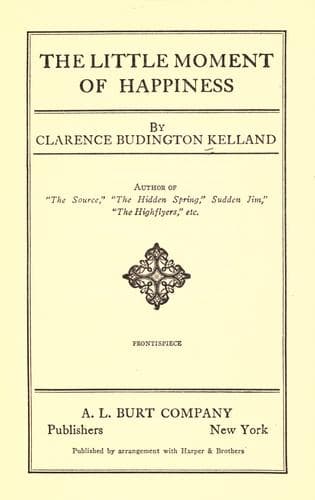
The Little Moment of HappinessKelland, Clarence Budington
General
The Little Moment of Happiness
Kelland, Clarence Budington
Man-woman relationships -- Fiction; World War, 1914-1918 -- Fiction
Ken tried to talk, Bert tried to talk, but the effort was futile. Dead,
cold silences fell.... The sensations of that meal would remain with
Kendall as long as he should live, a recurrent nightmare. Presently Bert
arose. He did a thing which he had never done before—lifted Andree’s
hand and touched it with his lips.
“I must go, mademoiselle,” he said. “Good-by.”
“Good-by, Monsieur Bert,” she said.
Then they were alone!
In the _salon_ he drew her down beside him on the sofa and held her
close.
“I am very sad, _mignonne_,” he said. “I love you....”
She studied his face a moment and smiled at very trifle of a smile.
“That is well,” she answered.
“I am not going away because I want to. It is orders. I have to obey.”
“_C’est la guerre_,” she said, gravely.
“Yes, it is the war, but it’s cruel—it’s rotten. I want to stay here, to
stay with you.”
“I wish that also,” she said.
Something was demanded of him. He must say something, must not keep this
child in agony, not knowing what he intended to do with respect to her.
It was her right to know.... He must decide, and he must tell her....
But again he put it off. There was time enough, and before he told her
there was still the chance of one last happy evening.... He wanted that,
wanted the memory of it, if nothing more.
“_Mignonne_, do you love me?” he asked.
“It is certain.”
“Very much?”
“I cannot say how much.”
“America is not far,” he said, with some idiotic intention to comfort
her. “The ocean can be crossed in a week.”
“That is true,” she said.
Her head was against his breast, her eyes staring into her lap. Ken
looked straight before him, thinking, thinking. His mind was very clear,
as if lighted by that painful white light which seemed to pour in upon
his consciousness in moments of mental stress. It seemed to him as if
his eyes could pierce the walls if he willed it, as if his memory could
show him every minute incident in his whole life, as if he could see and
understand everything—everything. He drew her to him fiercely, but even
as he was sensing the softness of her slender body against his side he
was seeing the vestibule of the Presbyterian church, he was watching it
function. The individuals stood before him as if alive, every well-known
feature distinct. It was photographic. He could see changes of
expression, hear whispers, see cautious hands placed before gossiping
lips ... and he could see himself passing through that little group with
Andree on his arm!...
Public-domain text, read in full here on John Shaqi.
Reviews
Reviews
No reviews yet
Be the first to share your thoughts on this work.
Elsewhere in the archive
Join the Discussion
Join the discussion
Sign in to leave a comment or review.
Sign InorCreate an account