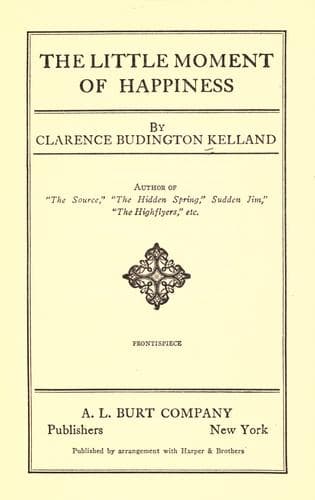
The Little Moment of HappinessKelland, Clarence Budington
General
The Little Moment of Happiness
Kelland, Clarence Budington
Man-woman relationships -- Fiction; World War, 1914-1918 -- Fiction
He could see his own home—his return to it. He could see his mother and
feel the hostility that sprang to life the instant her eyes rested on
Andree. He could read his mother’s thoughts ... and his father’s. There
was the one bright spot. He could see his father kissing Andree
diffidently and patting her hand and telling her how glad he was to see
her and asking how his son had ever managed to capture such a pretty
girl.... There would be no doubt of her welcome at his father’s
hands.... But his mother—that cold hostility, that hard-eyed
suspicion!... And then, when she had him alone, the catechism he would
undergo, and the resentment and jealousy she would exhibit....
He could see his friends and the neighbors of his childhood with their
crass curiosity and their hints and whispers.... He knew their every
thought ... could see their eyes fixed on Andree speculatively ... some
of them hopefully!
It was that he would have to take her, too.... And then, if the story
should come out!... But that would be little worse.... Perhaps he
exaggerated, perhaps he saw his old friends and acquaintances in
characters which were not truly theirs. There might have been more
charity among them than he perceived, more kindness and less narrowness
and insularity.... But he did not see them except as he feared they
might be.
What of himself? How would he feel to find himself married to a girl who
had violated the standards of Plymouth Rock, even though he had been the
one to profit by that violation?... Even if none ever found it out but
himself? He would know it.... It would constantly be recurring to him—or
would it not? He did not know. The thing did not affect him now. It did
not make Andree the less desirable and lovable and _good_. Perhaps that
would persist—but his prejudices were deep-seated, had their roots in an
older generation and were not lightly to be cast out....
But he loved her.... In spite of all that he saw and felt and feared, he
knew that he loved her, and that to know she was removed forever from
his life would be to lose a wonderful thing that he could not bear to
lose.... The decision lay between love and expediency.... If only he
could live in Paris and never return to America! How easy it would be
then!
“Will you miss me?” he asked, clumsily.
She stirred in his arms and held her face up to his. “I shall be ver’
sad,” she said.
“Suppose—suppose something should happen to me and I could never come
back?”
She held his hand very tightly. “I do not know,” she said. “I cannot to
theenk of that.”
He must decide.... He must decide.... But he was afraid; he _could not_
decide—not now, not yet.... There were hours ahead of them.
She asked nothing of him, made no demands, but waited, waited. He could
feel her waiting, hoping for some word, some assurance that he was not
going to desert her forever, that he would come back to her—and he could
not give that assurance ... not yet.
Public-domain text, read in full here on John Shaqi.
Reviews
Reviews
No reviews yet
Be the first to share your thoughts on this work.
Elsewhere in the archive
Join the Discussion
Join the discussion
Sign in to leave a comment or review.
Sign InorCreate an account