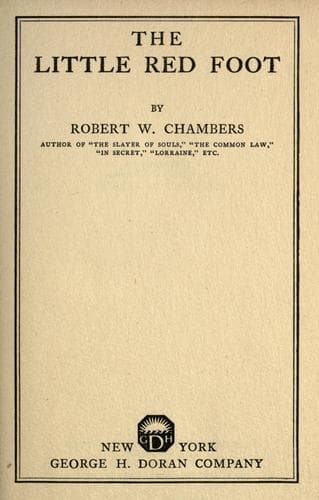
The Little Red FootChambers, Robert W. (Robert William)
History
The Little Red Foot
Chambers, Robert W. (Robert William)
New York (State) -- History -- Revolution, 1775-1783 -- Fiction
No man can pass through such years and remain what he was born. No man
can regret them; none can dare wish to live through such days again;
none would shun them. And how many months, or years, maybe, of fighting
still remain before us, no man can foretell. But the grim men in their
scare-crow regimentals who today, in the present year of 1780, are
closing ranks to prepare for future battles, even in the bitter
aftermath of defeat, seem to know, somehow, that this nation is
destined to survive.
* * * * *
From the month of August in 1777 to May, 1780, I had not seen Penelope;
I had asked for no leave to travel, knowing, by reason of my
confidential office and better than many others, how desperate was our
army's plight and how utterly every able-bodied man was needed.
In consequence, I had not seen my own Northland in all those months; I
had not seen Penelope. Letters I wrote and sent to her when opportunity
offered; letters came from her, and always written from Caughnawaga.
For it appeared that Douw Fonda had never consented to return to Albany;
but, by some miracle of God, the Valley so far had suffered no serious
harm. Yet, the terrible business at Wyoming renewed my every crudest
fear for the safety of Caughnawaga; and when, in the same year, a
Continental regiment of the Pennsylvania Line marched out from Schoharie
to destroy Unadilla, I, who knew the Iroquois, knew that their revenge
was certain to follow.
It followed in that very year; and Cherry Valley became a bloodsoaked
heap of cinders; and there, under Iroquois knife and hatchet, and under
the merciless clubbed muskets of the _blue-eyed_ Indians, many of my old
friends died--all of the Wells family save only one--old and young and
babies. What a crime was done by young Walter Butler on that fearful
day! And I sometimes wonder, now, what our generous but sentimental
young Marquis thinks of his deed of mercy when he saw and pitied Walter
Butler in an Albany prison, sick and under sentence of death, and
procured medical treatment for him and more comfortable quarters in a
private residence.
And Butler drugged his sentry and slipped our fingers like a rat and was
off in a trice and gone to his bloody destiny in the West!
Lord--Lord!--the things men do to men!
* * * * *
When Brant burned Minnisink I trembled anew for Caughnawaga; and
breathed freely only when our General Sullivan marched on Tioga with six
thousand men.
Yet, though he cleaned out the foul and hidden nests of the Iroquois
Confederacy, I, knowing these same Iroquois, knew in my dreading heart
that Iroquois vengeance would surely strike again, and this time at the
Valley.
Because, out of the Mohawk Valley, came all their chiefest woes;
Oriskany, which set the whole Six Nations howling their dead;
Stillwater; Unadilla; Tioga; The Chemung--these battles tore the
Iroquois to fragments.
Public-domain text, read in full here on John Shaqi.
Reviews
Reviews
No reviews yet
Be the first to share your thoughts on this work.
Elsewhere in the archive
Join the Discussion
Join the discussion
Sign in to leave a comment or review.
Sign InorCreate an account