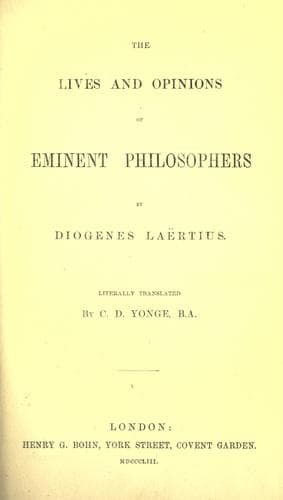
The Lives and Opinions of Eminent PhilosophersDiogenes Laertius
Philosophy
The Lives and Opinions of Eminent Philosophers
Diogenes Laertius
Philosophers, Ancient -- Biography; Philosophy, Ancient
XXV. Aristotle says, that the treatises of Plato are something between
poems and prose; and Phavorinus says, when Plato read his treatise on
the Soul, Aristotle was the only person who sat it out, and that all the
rest rose up and went away. And some say that Philip the Opuntian copied
out the whole of his books upon Laws, which were written on waxen tablets
only. Some people also attribute the Epinomis to him. Euphorion and
Panætius have stated that the beginning of the treatise on the Republic
was often altered and re-written; and that very treatise, Aristoxenus
affirms, was found almost entire in the Contradictions of Protagoras;
and that the first book he wrote at all was the Phædrus; and indeed
that composition has a good many indications of a young composer. But
Dicæarchus blames the whole style of that work as vulgar.
XXVI. A story is told, that Plato, having seen a man playing at dice,
reproached him for it, and that he said he was playing for a trifle; “But
the habit,” rejoined Plato, “is not a trifle.” On one occasion he was
asked whether there would be any monument of him, as of his predecessors
in philosophy? and he answered, “A man must first make a name, and the
monument will follow.” Once, when Xenocrates came into his house, he
desired him to scourge one of his slaves for him, for that he himself
could not do it because he was in a passion; and that at another time
he said to one of his slaves, “I should beat you if I were not in a
passion.” Having got on horseback he dismounted again immediately, saying
that he was afraid that he should be infected with horse-pride. He used
to advise people who got drunk to look in the glass, and then they would
abandon their unseemly habit; and he said that it was never decorous to
drink to the degree of drunkenness, except at the festivals of the God
who had given men wine. He also disapproved of much sleeping: accordingly
in his Laws he says, “No one while sleeping is good for anything.”
Another saying of his was, “That the pleasantest of all things to hear
was the truth;” but others report this saying thus, “That the sweetest of
all things was to speak truth.” And of truth he speaks thus in his Laws,
“Truth, my friend, is a beautiful and a durable thing; but it is not easy
to persuade men of this fact.”
XXVII. He used also to wish to leave a memorial of himself behind, either
in the hearts of his friends, or in his books.
XXVIII. He also used to travel a good deal as some authors inform us.
XXIX. And he died in the manner we have already mentioned, in the
thirteenth year of the reign of Philip of Macedon, as Phavorinus mentions
in the third book of his Commentaries; and Theopompus relates that Philip
on one occasion reproached him. But Myronianus, in his Resemblances, says
that Philo mentions some proverbs that were in circulation about Plato’s
lice; implying that he had died of that disease.
Public-domain text, read in full here on John Shaqi.
Reviews
Reviews
No reviews yet
Be the first to share your thoughts on this work.
Elsewhere in the archive
Join the Discussion
Join the discussion
Sign in to leave a comment or review.
Sign InorCreate an account