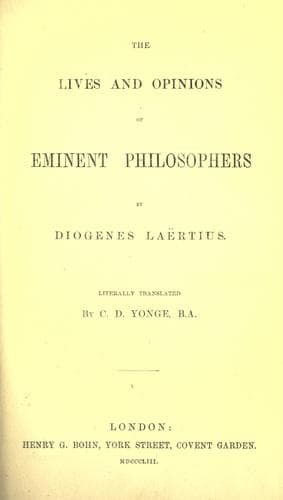
The Lives and Opinions of Eminent PhilosophersDiogenes Laertius
Philosophy
The Lives and Opinions of Eminent Philosophers
Diogenes Laertius
Philosophers, Ancient -- Biography; Philosophy, Ancient
XXX. He was buried in the Academy, where he spent the greater part of
his time in the practice of philosophy, from which his was called the
Academic school; and his funeral was attended by all the pupils of that
sect. And he made his will in the following terms:—“Plato left these
things, and has bequeathed them as follows.—The farm in the district of
the Hephæstiades, bounded on the north by the road from the temple of
the Cephisiades, and on the south by the temple of Hercules, which is
in the district of the Hephæstiades; and on the east by the estate of
Archestratus the Phrearrian, and on the west by the farm of Philip the
Chollidian, shall be incapable of being sold or alienated, but shall
belong to my son Adimantus as far as possible. And so likewise shall my
farm in the district of the Eiresides, which I bought of Callimachus,
which is bounded on the north by the property of Eurymedon the
Myrrhinusian, on the south by that of Demostratus of Xypeta, on the east
by that of Eurymedon the Myrrhinusian, and on the west by the Cephisus;—I
also leave him three minæ of silver, a silver goblet weighing a hundred
and sixty-five drachms, a cup weighing forty-five drachms, a golden ring,
and a golden ear-ring, weighing together four drachms and three obols.
Euclides the stone-cutter owes me three minæ. I leave Diana her liberty.
My slaves Tychon, Bictas, Apolloniades, and Dionysius, I bequeath to
my son; and I also give him all my furniture, of which Demetrius has
a catalogue. I owe no one anything. My executors shall be Sosthenes,
Speusippus, Demetrius, Hegias, Eurymedon, Callimachus, and Thrasippus.”
This was his will. And on his tomb the following epigrams were inscribed.
First of all:—
Here, first of all men for pure justice famed,
And moral virtue, Aristocles lies;
And if there e’er has lived one truly wise,
This man was wiser still; too great for envy.
A second is:—
Here in her bosom does the tender earth
Embrace great Plato’s corpse.—His soul aloft
Has ta’en its place among the immortal Gods.
Ariston’s glorious son—whom all good men,
Though in far countries, held in love and honour,
Remembering his pure and god-like life.
There is another which is more modern:—
_A._ Eagle, why fly you o’er this holy tomb?
Or are you on your way, with lofty wing,
To some bright starry domicile of the Gods?
_B._ I am the image of the soul of Plato,
And to Olympus now am borne on high;
His body lies in his own native Attica.
We ourselves also have written one epigram on him, which is as follows:—
If fav’ring Phœbus had not Plato given
To Grecian lands, how would the learned God
Have e’er instructed mortal minds in learning?
But he did send him, that as Æsculapius
His son’s the best physician of the body,
So Plato should be of the immortal soul.
And others, alluding to his death:—
Public-domain text, read in full here on John Shaqi.
Reviews
Reviews
No reviews yet
Be the first to share your thoughts on this work.
Elsewhere in the archive
Join the Discussion
Join the discussion
Sign in to leave a comment or review.
Sign InorCreate an account