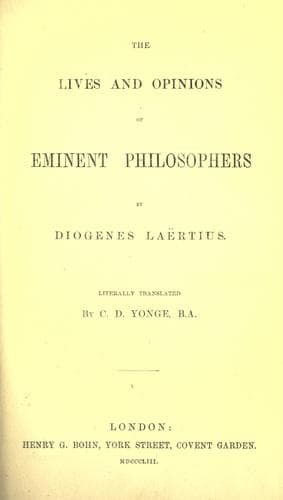
The Lives and Opinions of Eminent PhilosophersDiogenes Laertius
Philosophy
The Lives and Opinions of Eminent Philosophers
Diogenes Laertius
Philosophers, Ancient -- Biography; Philosophy, Ancient
Phœbus, to bless mankind, became the father
Of Æsculapius, and of god-like Plato;
_That_ one to heal the body, _this_ the mind.
Now, from a marriage feast he’s gone to heaven,
To realize the happy city there,
Which he has planned fit for the realms of Jove.
These then are the epigrams on him.
XXXI. His disciples were, Speusippus the Athenian, Zenocrates of
Chalcedon, Aristotle the Stagirite, Philip of Opus, Histiæus of
Perinthus, Dion of Syracuse, Amyclus of Heraclea, Erastus and Coriscus of
Sceptos, Timolaus of Cyzicus, Eudon of Lampsacus, Pithon and Heraclides
of Æmus, Hippothales and Callippus, Athenians, Demetrius of Amphipolis,
Heraclides of Pontus, and numbers of others, among whom there were also
two women, Lasthenea of Mantinea, and Axiothea of Phlius, who used even
to wear man’s clothes, as we are told by Dicæarchus. Some say that
Theophrastus also was a pupil of his; and Chamælion says that Hyperides
the orator, and Lycurgus, were so likewise. Polemo also asserts that
Demosthenes was. Sabinus adds Mnesistratus of Thasos to the number,
quoting authority for the statement in the fourth book of his Meditative
Matter; and it is not improbable.
XXXII. But as you, O lady, are rightly very much attached to Plato, and
as you are very fond of hunting out in every quarter all the doctrines
of the philosopher with great eagerness, I have thought it necessary
to subjoin an account of the general character of his lectures, and of
the arrangement of his dialogues, and of the method of his inductive
argument; going back to their elements and first principles as far as
I could, so that the collection of anecdotes concerning his life which
I have been able to make, may not be curtailed by the omission of any
statement as to his doctrines. For it would be like sending owls to
Athens, as the proverb is, if I were to descend to particular details.
Public-domain text, read in full here on John Shaqi.
Reviews
Reviews
No reviews yet
Be the first to share your thoughts on this work.
Elsewhere in the archive
Join the Discussion
Join the discussion
Sign in to leave a comment or review.
Sign InorCreate an account