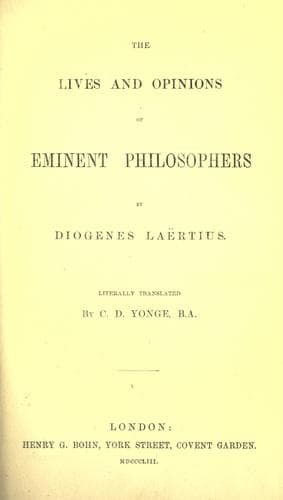
The Lives and Opinions of Eminent PhilosophersDiogenes Laertius
Philosophy
The Lives and Opinions of Eminent Philosophers
Diogenes Laertius
Philosophers, Ancient -- Biography; Philosophy, Ancient
But we are not unaware that some writers distinguish the various
dialogues in a different manner from what we do. For they say that
some of them are dramatic, and others narrative, and others of a mixed
nature. But they, in this division, are classifying the dialogues in a
theatrical rather than in a philosophical manner. Some of the dialogues
also refer to subjects of natural philosophy, such as the Timæus. Of the
logical class, there are the Politics, the Cratylus, the Parmenides, and
the Sophist. Of the ethical kind there is the defence of Socrates, the
Crito, the Phædo, the Phædrus, the Banquet, the Menexenus, the Clitophon,
the Epistles, the Philebus, the Hipparchus, and the Rival Lovers. Of
the political class there is the Republic, the Laws, the Minos, the
Epinomis, and the Atlanticus. Of the midwife description we have the
two Alcibiades’s, the Theages, the Lysis, the Laches. Of the tentative
kind, there is the Euthyphro, the Meno, the Ion, the Charmides, and the
Theætetus. Of the demonstrative description, we have the Protagoras,
and of the distinctive class the Euthydemus, the two Hippias’s, and the
Gorgias. And this is enough to say about the dialogues as to what they
are, and what their different kinds are.
XXXIII. But since there is also a great division of opinion respecting
them, from some people asserting that in them Plato dogmatizes in a
positive manner, while others deny this, we had better also touch upon
this part of the question. Now, dogmatizing is laying down dogmas, just
as legislating is making laws. But the word dogma is used in two senses;
to mean both that which we think, and opinion itself. Now of these,
that which we think is the proposition, and opinion is the conception
by which we entertain it in our minds. Plato then explains the opinions
which he entertains himself, and refutes false ones; and about doubtful
matters he suspends his judgment. His opinions of matters as they appear
to him he puts into the mouth of four persons, Socrates, Timæus, an
Athenian poet, and an Eleatic stranger. But the strangers are not, as
some people have supposed, Plato and Parmenides, but certain nameless
imaginary characters. Since Plato asserts as undeniable axioms all the
opinions which he puts into the mouth of Socrates or Timæus. But when
he is refuting false propositions, he introduces such characters as
Thrasymachus, and Callicles, and Polus, and Gorgias, and Protagoras,
Hippias too, and Euthydemus, and men of that stamp. But when he is
demonstrating anything, then he chiefly uses the inductive form of
argument, and that too not of one kind only, but of two. For induction is
an argument, which by means of some admitted truths establishes naturally
other truths which resemble them. But there are two kinds of induction;
the one proceeding from contraries, the other from consequents. Now,
the one which proceeds from contraries, is one in which from the answer
given, whatever that answer may be, the contrary of the principle
Public-domain text, read in full here on John Shaqi.
Reviews
Reviews
No reviews yet
Be the first to share your thoughts on this work.
Elsewhere in the archive
Join the Discussion
Join the discussion
Sign in to leave a comment or review.
Sign InorCreate an account