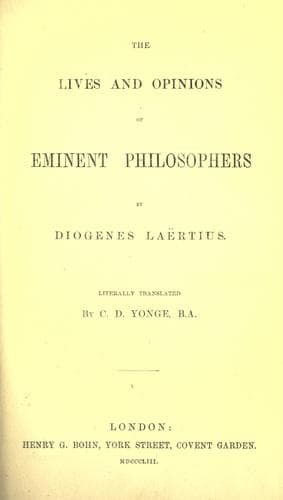
The Lives and Opinions of Eminent PhilosophersDiogenes Laertius
Philosophy
The Lives and Opinions of Eminent Philosophers
Diogenes Laertius
Philosophers, Ancient -- Biography; Philosophy, Ancient
indicated in the question must follow. As for instance. My father is
either a different person from your father, or he is the same person.
If now your father is a different person from my father, then as he is
a different person from a father, he cannot be a father. If, on the
other hand, he is the same person as my father, then, since he is the
same person as my father, he must be my father. And again, if man be not
an animal, he must be either a stone or a piece of wood; but he is not
a stone or a piece of wood, for he is a living animal, and capable of
independent motion. Therefore, he is an animal. But, if he is an animal,
and a dog or an ox is likewise an animal, then man must be an animal, and
a dog, and an ox.—This then is the method of induction in contradiction
and contention, which Plato was accustomed to employ, not for the purpose
of establishing principles of his own, but with the object of refuting
the arguments of others.
Now, the inductive kind of argument drawn from consequents is of a
twofold character. The one proving a particular opinion by an admitted
fact of an equally particular nature; or else going from particulars to
generals. And the first of these two divisions is the oratorical one,
the second the dialectic one. As for instance, in the former kind the
question is whether this person has committed a murder; the proof is that
he was found at the time covered with blood. But this is the oratorical
method of employing the induction; since oratory is conversant about
particulars, and does not concern itself about generals. For its object
is not to ascertain abstract justice, but only particular justice.
The other is the dialectic kind, the general proposition having been
established by particular ones. As for instance, the question is whether
the soul is immortal, and whether the living consist of those who have
once been dead; and this proposition Plato establishes in his book on
the Soul, by a certain general proposition, that contraries arise out
of contraries; and this identical general proposition is established by
certain particular ones. As, for instance, that sleep follows on waking,
and waking from sleeping, and the greater from the less, and reversely
the less from the greater. And this kind of induction he used to employ
for the establishment of his own opinions.
XXXIV. Anciently, in tragedy, it was only the chorus who did the whole
work of the play; but subsequently, Thespis introduced one actor for the
sake of giving the chorus some rest, and Æschylus added a second, and
Sophocles a third, and so they made tragedy complete. So in the same
manner, philosophical discourse was originally uniform, concerning itself
solely about natural philosophy; then Socrates added to it a second
character, the ethical: and Plato a third, the dialectic: and so he
brought philosophy to perfection.
Public-domain text, read in full here on John Shaqi.
Reviews
Reviews
No reviews yet
Be the first to share your thoughts on this work.
Elsewhere in the archive
Join the Discussion
Join the discussion
Sign in to leave a comment or review.
Sign InorCreate an account