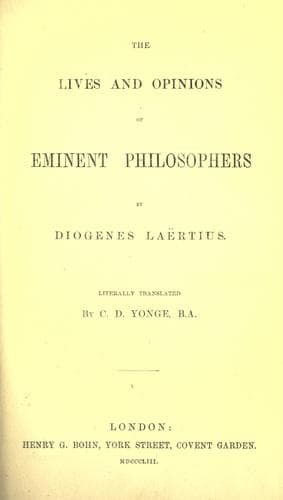
The Lives and Opinions of Eminent PhilosophersDiogenes Laertius
Philosophy
The Lives and Opinions of Eminent Philosophers
Diogenes Laertius
Philosophers, Ancient -- Biography; Philosophy, Ancient
The first dialogue in the eighth is the Clitophon, or the Exhortation,
a moral piece. Then comes the Republic, or the treatise on Justice, a
political one. The Timæus, or a dissertation on Nature, a dialogue on
Natural Philosophy. And the Critias, or Atlanticus, a moral one.
The ninth begins with the Minos, or a treatise on Law, a political work.
The Laws, or a dissertation on Legislation, another political work. The
Epinomis, or the Nocturnal Conversation, or the Philosopher, a third
political one.
XXXVI. And this last tetralogy is completed by thirteen epistles, all
moral; to which is prefixed as a motto, εὖ πράττειν, just as Epicurus
inscribed on his εὖ διάγειν, and Cleon on his χαίρειν. They are, one
letter to Aristodemus, two to Archytas, four to Dionysius, one to
Hermeias, Erastus, and Coriscus, one to Leodamas, one to Dion, one to
Perdiccas, and two to the friends of Dion.
XXXVII. And this is the way in which some people divide his works. But
others, among whom is Aristophanes, the grammarian, arrange his dialogues
in trilogies; and they make the first to consist of the Republic, the
Timæus and the Critias.
The second of the Sophist, the Statesman, the Cratylus.
The third of the Laws, the Minos, the Epinomis.
The fourth of the Theætetus, the Euthyphro, the Defence of Socrates.
The fifth of the Crito, the Phædo, the Epistles.
And the rest they arrange singly and independently, without any regular
order. And some authors, as has been said already, place the Republic at
the head of his works: others begin with the Greater Alcibiades: others
with the Theages; some with the Euthyphro, others with the Clitophon;
some with the Timæus, some with the Phædrus, others again with the
Theætetus. Many make the Defence of Socrates the first piece.
There are some dialogues attributed to him which are confessedly
spurious. The Midon, or the Horse-breeder; the Eryxias, or Erasistratus;
the Alcyon; the Acephali, or Sisyphi; the Axiochus; the Phæacians; the
Demodorus; the Chelidon; the Seventh; the Epimenides. Of which the Alcyon
is believed to be the work of a man named Leon; as Phavorinus tells us in
the seventh book of his Commentaries.
Public-domain text, read in full here on John Shaqi.
Reviews
Reviews
No reviews yet
Be the first to share your thoughts on this work.
Elsewhere in the archive
Join the Discussion
Join the discussion
Sign in to leave a comment or review.
Sign InorCreate an account