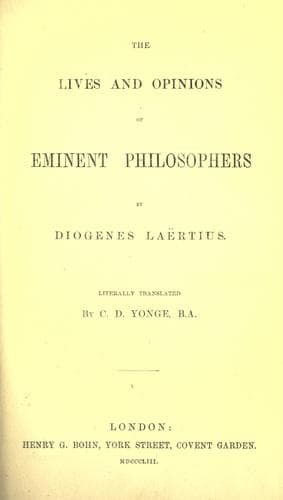
The Lives and Opinions of Eminent PhilosophersDiogenes Laertius
Philosophy
The Lives and Opinions of Eminent Philosophers
Diogenes Laertius
Philosophers, Ancient -- Biography; Philosophy, Ancient
XXXV. But Thrasybulus says that he published his dialogues as the
dramatic poets published their tetralogies. For, they contended with
four plays, (and at four festivals, the Dionysiac, the Lenæan, the
Panathenæan, and the Chytri), one of which was a satiric drama, and
the whole four plays were called a tetralogy. Now, people say, the
whole of his genuine dialogues amount to fifty-six; the treatise on the
Republic being divided into ten books, (which Phavorinus, in the second
book of his Universal History, says may be found almost entire in the
Contradictions of Protagoras), and that on Laws into twelve. And there
are nine tetralogies, if we consider the Republic as occupying the place
of one book, and the Laws of another. He arranges, therefore, the first
tetralogy of these dialogues which have a common subject, wishing to show
what sort of life that of the philosopher may have been. And he uses two
titles for each separate book, taking one from the name of the principal
speaker, and the other from the subject.
This tetralogy then, which is the first, is commenced by the Euthyphron,
or what is Holy; and that dialogue is a tentative one. The second is the
Defence of Socrates, a moral one. The third is the Criton, or What is to
be done, a moral one. The fourth is the Phædo, or the Dialogue on the
Soul, a moral one.
The second tetralogy is that of which the first piece is the Cratylus, or
the correctness of names, a logical one. The Theætetus, or Knowledge, a
tentative one. The Sophist, or a dialogue on the Existent, a logical one.
The Statesman, or a dialogue of Monarchy, a logical one.
The first dialogue in the third tetralogy is the Parmenides, or a
dialogue of Ideas, a logical one. The second is the Philebus, or on
Pleasure, a moral one. The Banquet, or on the Good, a moral one. The
Phædrus, or on Love, a moral one.
The fourth tetralogy opens with the Alcibiades, or a treatise on the
Nature of Man, a midwife-like work. The second Alcibiades, or on Prayer,
a piece of the same character. The Hipparchus, or on the Love of Gain, a
moral one. The Rival Lovers, or a treatise on Philosophy, a moral one.
The first dialogue in the fifth is the Theages, or another treatise on
Philosophy, another midwife-like work. The Charmides, or on Temperance,
a tentative essay. The Laches, or on Manly Courage, midwife-like. The
Lysis, or a dissertation on Friendship, also midwife-like.
The sixth tetralogy commences with the Euthydemus, or the Disputatious
Man, a distinctive dialogue. Then comes the Protagoras, or the Sophists,
a demonstrative one. The Gorgias, or a dissertation on Rhetoric, another
distinctive one. And the Meno, or on Virtue, a tentative dialogue.
The seventh begins with the two Hippias’s. The first being a dissertation
on the Beautiful, the second one on Falsehood, both distinctive. The
third is the Ion, or a dissertation on the Iliad, a tentative one. The
fourth is the Menexenus, or the Funeral Oration, a moral one.
Public-domain text, read in full here on John Shaqi.
Reviews
Reviews
No reviews yet
Be the first to share your thoughts on this work.
Elsewhere in the archive
Join the Discussion
Join the discussion
Sign in to leave a comment or review.
Sign InorCreate an account