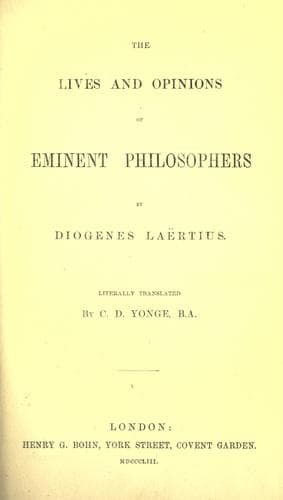
The Lives and Opinions of Eminent PhilosophersDiogenes Laertius
Philosophy
The Lives and Opinions of Eminent Philosophers
Diogenes Laertius
Philosophers, Ancient -- Biography; Philosophy, Ancient
XLI. Plato lays down two primary causes or principles of all things, God
and matter, which he also calls mind, and the cause. And he defines
matter as something without shape and without limitation, and says that
from it all concretions arise. He affirms also that as it was moving
about at random, it was brought by God into one settled place, as God
thought order better than disorder; and that this nature is divided into
four elements, fire, water, air, and earth, of which the world itself and
everything in it was made. But he says that the earth is the only thing
that is unchangeable, as he considers the cause to be the difference of
the figures of which it is composed; for he says that the figures of the
others are homogeneous; for that they are all composed equally of scalene
triangles. The figure of the earth, however, is peculiar to itself;
for the element of fire is a pyramid; of air, an octagon; of water, an
eicosagon; and of the earth, a cube; owing to which these things cannot
be changed into earth, nor earth into them. He teaches also that these
elements are not separated so as to occupy each a peculiar and distinct
place; for the spherical motion collects and compresses all the small
things towards the centre, and the small things separate the great ones,
on which account the species, as they change, do also change their
positions.
Moreover he asserts that the world is one, and has been produced,
since it has been made by God, in such a manner as to be an object
of sensation. And he considers it endowed with life, because that
which is so endowed, is superior to that which is not, and it must be
the production of the most excellent producer. It is also one, and
illimitable; because the model after which it was made was one; and it
is spherical, because its creator was of that form; for it also contains
all other animals, and God who made it comprises all forms. And it is
smooth, and has no instruments whatever all round it, because it has no
need of any. But the whole world remains imperishable, because it cannot
be resolved into God; and God is the cause of universal production,
because it is the nature of the good to be productive of good; and the
best is the cause of the production of the heaven; for the best of all
productions can have no other cause than the best of all intelligible
existences. And since God is of that character, and since heaven
resembles the best, inasmuch as it is at least the most beautiful of all
things, it cannot be like anything else that is produced, except God.
Public-domain text, read in full here on John Shaqi.
Reviews
Reviews
No reviews yet
Be the first to share your thoughts on this work.
Elsewhere in the archive
Join the Discussion
Join the discussion
Sign in to leave a comment or review.
Sign InorCreate an account