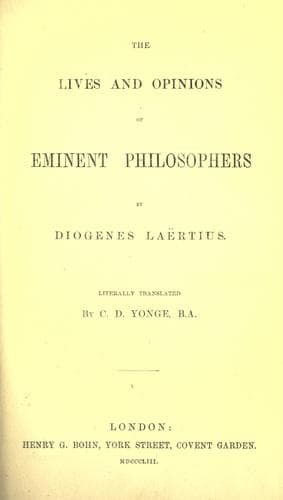
The Lives and Opinions of Eminent PhilosophersDiogenes Laertius
Philosophy
The Lives and Opinions of Eminent Philosophers
Diogenes Laertius
Philosophers, Ancient -- Biography; Philosophy, Ancient
He also teaches that the world consists of fire, water, air, and earth;
of fire, in order that it may be visible; of earth, in order that it may
be firm; of water and air, that it may not be destitute of proportion;
for two middle terms are indispensable to keep the solid bodies in due
proportion to one another, and to realize the unity of the whole. In
short, the world is formed of all the elements together, in order that it
may be perfect and imperishable.
Again, time is the image of eternity; eternity subsists for ever; but the
motion of the heaven is time; for day, and night, and the months, and all
such divisions, are parts of time, on which account there could be no
such thing as time apart from the nature of the world; for time existed
contemporaneously and simultaneously with the world. And it was with
reference to time that the sun, and the moon, and the planets were made;
and it was in order that the number of the seasons might be manifest, and
that the animals might partake of number, that God kindled the light of
the sun; and that the moon was above the circle of the earth, and that
the sun was next to it, and in the still higher circles were the planets.
And that the universe was animated, because it was altogether bound up
in animated motion, and that the race of all other animals was produced
in order that the world might be made perfect, and resembling an animal
such as could be comprehended by intellect. Since then God had life, the
heaven also must have life; and the Gods are to a great extent composed
of fire. And there are three other races of animals, those which fly in
the air; those which live in the water; those which walk in the earth.
The oldest of all the deities in heaven is the Earth; she was formed in
order to be the dispenser of night and day; and as she is placed in the
centre, she is constantly in motion around the centre.
And since there are two efficient causes, some things must, he says,
be affirmed to exist in consequence of intellect, and some from some
necessary cause. Now necessary causes are the air, fire, earth, and
water, these not being real elements, but rather receptacles; and
they too are formed of triangles in combination, and are resolvable
into triangles; and their elements are the scalene triangle and the
isosceles. These two before mentioned elements are the principles and
causes of things, of which the models are God and matter, which last must
necessarily be destitute of form, as is the case of other receptacles.
And that the cause of these things was a necessary cause, which,
receiving the ideas, produced the substances, and was moved by the
dissimilarity of its own power, and again by its motion compelled those
things which were moved by it to move other things in their turn.
Public-domain text, read in full here on John Shaqi.
Reviews
Reviews
No reviews yet
Be the first to share your thoughts on this work.
Elsewhere in the archive
Join the Discussion
Join the discussion
Sign in to leave a comment or review.
Sign InorCreate an account