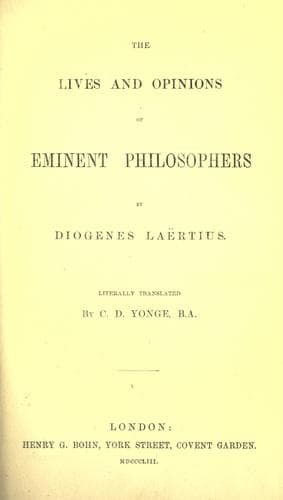
The Lives and Opinions of Eminent PhilosophersDiogenes Laertius
Philosophy
The Lives and Opinions of Eminent Philosophers
Diogenes Laertius
Philosophers, Ancient -- Biography; Philosophy, Ancient
But all these things were formerly moved without any reason or order;
but after they began to form the world by their combination, they then
received symmetry and regularity from God, according to the principles
applicable to them; for the efficient causes, even before the creation
of the heaven, were two in number. There was also a third, namely
production; but these were not very evident, but rather traces than
actual things, and quite devoid of regularity. But after the world was
made, then they too assumed a regular form and arrangement; but the
heaven was made of all existing bodies. And Plato considers that God is
incorporeal just as the soul is, and that it is owing to that that he is
not affected by any destruction or external circumstances. And ideas, as
we have said before, he defines as certain causes and principles, owing
to which it is that such and such things are by nature what they are.
XLII. On the subject of good and evil, these were his sentiments: that
the end was to become like God; and that virtue was sufficient of herself
for happiness, but nevertheless required the advantages of the body as
instruments to work with; such as health, strength, the integrity of
the senses, and things of that kind; and also external advantages, such
as riches, and noble birth, and glory. Still that the wise man would be
not the less happy, even if destitute of these auxiliary circumstances;
for he would enjoy the constitution of his country, and would marry, and
would not transgress the established laws, and that he would legislate
for his country, as well as he could under existing circumstances,
unless he saw affairs in an unmanageable condition, in consequence of
the excessive factiousness of the people. He thinks too that the Gods
superintend all the affairs of men, and that there are such beings
as dæmons. And he was the first person who defined the notion of the
honourable, as that which borders on the praiseworthy, and the logical,
and the useful, and the becoming, and the expedient, all which things are
combined with that which is suitable to, and in accordance with, nature.
XLIII. He also discussed in his dialogues the correctness of terms, so
that he was the first person who reduced the science of giving correct
answers, and putting correct questions to a system, which he himself used
to satiety.
XLIV. In his dialogues he used to speak of justice as a kind of law of
God, as being of influence sufficient to excite men to act justly, in
order to avoid suffering punishment as malefactors after death. Owing
to which he appeared to some people rather fond of mythical stories,
as he mingled stories of this kind with his writings, in order by the
uncertainty of all the circumstances that affect men after their death,
to induce them to abstain from evil actions. And these were his opinions.
Public-domain text, read in full here on John Shaqi.
Reviews
Reviews
No reviews yet
Be the first to share your thoughts on this work.
Elsewhere in the archive
Join the Discussion
Join the discussion
Sign in to leave a comment or review.
Sign InorCreate an account