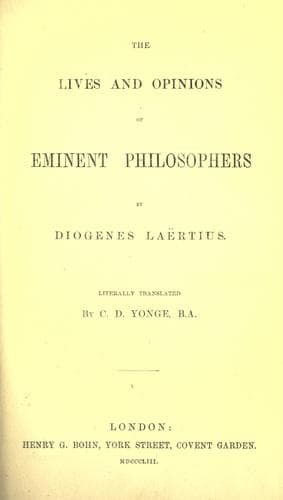
The Lives and Opinions of Eminent PhilosophersDiogenes Laertius
Philosophy
The Lives and Opinions of Eminent Philosophers
Diogenes Laertius
Philosophers, Ancient -- Biography; Philosophy, Ancient
LII. Discourse is divided into five heads; one of which heads is that
which statesmen employ when they speak in the public assemblies; and
this is called political. Another division is that which orators use in
their written harangues, and bring forward for the sake of display in
panegyrics or reproaches, or impeachments. And such a description of
discourse as this is the rhetorical. A third class is that which private
individuals use when conversing with one another. This is called private
discourse. Another kind is that which is employed when men converse
by means of putting short questions and giving brief answers to those
who question them. This is called the dialectic kind of discourse.
The fifth division is that which artists adopt when conversing on
their own particular art, and this is called professional discourse.
Thus discourse, then, is divided into political, rhetorical, private,
dialectic, and professional.
LIII. Music again is divided into three species. For there is the music
of the mouth alone, such as song; secondly, there is the music which is
performed by the hands and mouth together, such as singing to the harp;
thirdly, there is that which is executed by the hands alone, such as harp
playing. Music, therefore, is divided into music of the mouth, music of
the mouth and hands, and music of the hands.
LIV. Nobleness of birth is divided into four species; the first is when
one’s ancestors are noble, and valiant, and just; in which case they
say that their posterity are nobly born. The second kind is when one’s
ancestors have been princes and rulers of nations, and their posterity
also we call noble. Another kind is when one’s ancestors have been
distinguished for personal renown, such, for instance, as is gained by
generalship or by victory at the games. For their offspring also we
address as nobly born. And the last kind is when a man is himself noble
in his spirit, and magnanimous. For that man also we call noble, and this
is the last kind of nobility. There is, therefore, nobility arising from
virtuous ancestors, from royal ancestors, from illustrious ancestors, and
from one’s own excellent qualities.
LV. Beauty also is divided into three kinds. For there is one kind
which is praiseworthy, as that of a beautiful face. Another which is
useful, as an instrument or a house, and things of that kind which are
beautiful, with reference to our use of them. There is also a beauty with
reference to laws, and habits, and things of that kind, which is likewise
beautiful, because of its utility. So that beauty again is looked at in
three ways, with reference to its praise, its utility, and to our use of
it.
Public-domain text, read in full here on John Shaqi.
Reviews
Reviews
No reviews yet
Be the first to share your thoughts on this work.
Elsewhere in the archive
Join the Discussion
Join the discussion
Sign in to leave a comment or review.
Sign InorCreate an account