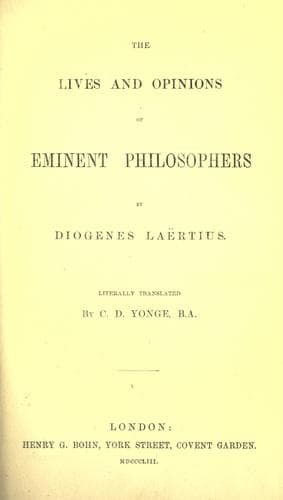
The Lives and Opinions of Eminent PhilosophersDiogenes Laertius
Philosophy
The Lives and Opinions of Eminent Philosophers
Diogenes Laertius
Philosophers, Ancient -- Biography; Philosophy, Ancient
LXIV. Happiness is divided into five parts. For one part of it is wisdom
in counsel; another is a healthy condition of the sensations and general
health of body; a third is good fortune in one’s affairs; a fourth kind
is good reputation among men; a fifth is abundance of riches and of all
those things which are useful in life. Now wisdom in counsel arises from
good instruction, and from a person’s having experience of many things.
A healthy condition of the sensations depends on the limbs of the body;
as, for instance, when one sees with one’s eyes, and hears with one’s
ears, and smells with one’s nose, and feels with one’s body, just what
one ought to see, and hear, and smell, and feel. Such a condition as
this is a healthy condition. And good fortune is when a man does rightly
and successfully what a good and energetic man ought to do. And good
reputation is when a man is well spoken of. And abundance of riches is
when a man has such a sufficiency of everything which relates to the uses
of life, that he is able to benefit his friends, and to discharge all
public obligations in a splendid and liberal manner. And the man who has
all these different parts of happiness, is a perfectly happy man. So
that happiness is made up of wisdom in counsel, a good condition of the
sensations and health of body, good fortune, good reputation, and riches.
LXV. The arts are divided into three kinds. The first, the second, and
the third. The first are those of working mines and cutting wood, for
these are preparatory arts. The second are such as working metals and
carpentry, for they are alterative arts. For working in metals makes arms
out of iron; and carpentry makes flutes and lyres out of wood. The third
is the art which makes use of instruments; such as horsemanship, which
uses bridles; the military art, which uses arms; music, which uses flutes
and lyres. So that there are three species of art; one of which is the
first, another the second, and another the third.
LXVI. Good is divided into four kinds. One of which we mean when we speak
of a man endowed with private virtue, as good; another kind is that which
we indicate, when we call virtue and justice, good. A third kind is that
which we attribute to suitable food, and exercise, and medicine. The
fourth good, is that which we mean, when we speak of good flute playing,
good acting, and things of that sort. There are therefore four kinds of
good. One the having virtue; another, virtue itself; a third, useful food
and exercise; and fourthly, we call skill in flute playing and acting,
good.
Public-domain text, read in full here on John Shaqi.
Reviews
Reviews
No reviews yet
Be the first to share your thoughts on this work.
Elsewhere in the archive
Join the Discussion
Join the discussion
Sign in to leave a comment or review.
Sign InorCreate an account