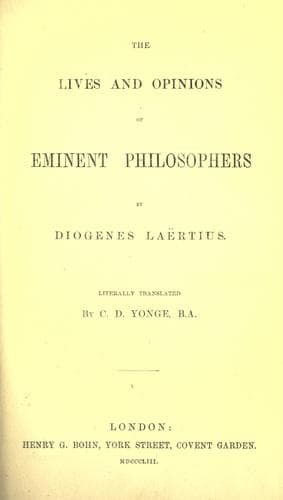
The Lives and Opinions of Eminent PhilosophersDiogenes Laertius
Philosophy
The Lives and Opinions of Eminent Philosophers
Diogenes Laertius
Philosophers, Ancient -- Biography; Philosophy, Ancient
LXVII. Of things existing, some are bad, some good, and some neither
one thing nor the other. Of these, we call those things bad, which
are invariably capable of doing injury, such as intemperance, folly,
injustice, and things of that sort. And the opposites to these qualities
are good. But those things, which may at times be beneficial, and at
times injurious, such as walking, sitting down, and eating; or which have
absolutely no power in any case to benefit or injure any one; these are
neither bad nor good. Of things existing then, there are some bad, and
some good, and some of a neutral character, neither bad nor good.
LXVIII. A good state of affairs with reference to the laws, is divided
under three heads. One when the laws are good, for that is a good state
of affairs; so too is it, when the citizens abide by the existing laws;
and the third case is, when although there are no positive laws,
still men are good citizens in deference to custom and to established
institutions; and this is also called a good state of affairs. So that
of these three heads, one depends on the laws being good, another on
obedience to existing laws, and the third on men yielding to good customs
and institutions.
So again, lawlessness is divided into three heads. One of which is,
when the laws are bad, both as concerns strangers, and the citizens;
another, when the citizens do not obey the laws that are established; and
the third is when there is actually no law at all. So that one kind of
lawlessness arises from bad laws, another from disobedience to existing
laws, and the third from the absence of laws.
LXIX. Contraries are of three sorts; for instance, we say that good
is contrary to evil, as justice to injustice, wisdom to folly, and so
on. Again, some evils are contrary to others, as extravagance is to
stinginess, and the being tortured with justice to the being tortured
with injustice. And such evils as these are the contraries of other
evils. Again, the heavy is contrary to the light, the swift to the slow,
the black to the white; so that some things which are of a neutral
character, neither good nor evil, are contrary to other things of a
neutral character. Of contraries then, there are some which are so, as
what is good is contrary to what is evil; others, as one evil is contrary
to another; and others again, as neutral things are contrary to other
things of a neutral character.
Public-domain text, read in full here on John Shaqi.
Reviews
Reviews
No reviews yet
Be the first to share your thoughts on this work.
Elsewhere in the archive
Join the Discussion
Join the discussion
Sign in to leave a comment or review.
Sign InorCreate an account