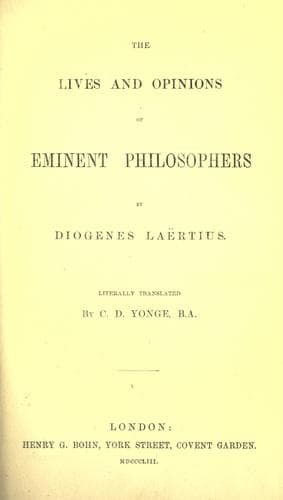
The Lives and Opinions of Eminent PhilosophersDiogenes Laertius
Philosophy
The Lives and Opinions of Eminent Philosophers
Diogenes Laertius
Philosophers, Ancient -- Biography; Philosophy, Ancient
IV. And he always adhered to the doctrines which had been adopted by
Plato, though he was not of the same disposition as he. For he was a
passionate man, and a slave to pleasure. Accordingly, they say that
he once in a rage threw a puppy into a well; and that for the sake of
amusement, he went all the way to Macedonia to the marriage of Cassander.
V. The female pupils of Plato, Lasthenea of Mantinea, and Axiothea
of Phlius, are said to have become disciples of Speusippus also. And
Dionysius, writing to him in a petulant manner, says, “And one may learn
philosophy too from your female disciple from Arcadia; moreover, Plato
used to take his pupils without exacting any fee from them; but you
collect tribute from yours, whether willing or unwilling.”
VI. He was the first man, as Diodorus relates in the first book of his
Commentaries, who investigated in his school what was common to the
several sciences; and who endeavoured, as far as possible, to maintain
their connection with each other. He was also the first who published
those things which Isocrates called secrets, as Cæneus tells us. And the
first too who found out how to make light baskets of bundles of twigs.
VII. But he became afflicted with paralysis, and sent to Xenocrates
inviting him to come to him, and to become his successor in his school.
VIII. And they say that once, when he was being borne in a carriage into
the Academy, he met Diogenes, and said, “Hail;” and Diogenes replied, “I
will not say hail to you, who, though in such a state as you are, endure
to live.”
IX. And at last in despair he put an end to his life, being a man of a
great age. And we have written this epigram on him:—
Had I not known Speusippus thus had died,
No one would have persuaded me that he
Was e’er akin to Plato; who would never
Have died desponding for so slight a grief.
But Plutarch, in his Life of Lysander, and again in his Life of Sylla,
says that he was kept in a state of constant inflammation by lice. For
he was of a weak habit of body, as Timotheus relates in his treatise on
Lives.
X. Speusippus said to a rich man who was in love with an ugly woman,
“What do you want with her? I will find you a much prettier woman for ten
talents.”
Public-domain text, read in full here on John Shaqi.
Reviews
Reviews
No reviews yet
Be the first to share your thoughts on this work.
Elsewhere in the archive
Join the Discussion
Join the discussion
Sign in to leave a comment or review.
Sign InorCreate an account