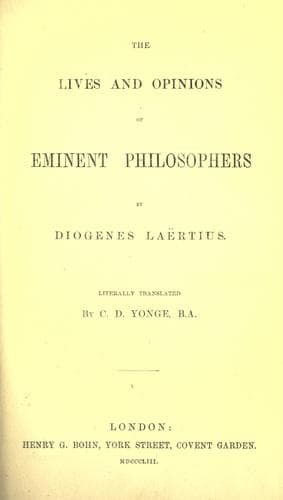
The Lives and Opinions of Eminent PhilosophersDiogenes Laertius
Philosophy
The Lives and Opinions of Eminent Philosophers
Diogenes Laertius
Philosophers, Ancient -- Biography; Philosophy, Ancient
LXXIII. Of existing things, some are divisible and some indivisible.
Again, those which are divisible, consist either of similar or of
dissimilar parts. Those which are indivisible are such as have no
separate parts, and are not formed by any combination, such as unity,
a point, or a sound. But those are divisible which are formed by some
combination; as, for instance, syllables, and symphonies, and animals,
and water, and gold. These too consist of similar parts, which are made
up of particles resembling one another, and of which the whole does
not differ from any part, except in number. As for instance, water and
gold, and everything which is fusible, and so on. And these consist of
dissimilar parts, which are made up of various things not resembling one
another; as for instance, a house, and things of that sort; so that of
existing things, some are divisible and others indivisible. And of those
which are divisible, some consist of similar and others of dissimilar
parts.
LXXIV. Again, of existing things, some are spoken of as having an
independent, and some only a relative existence. Those which are spoken
of as having an independent existence, are those which require nothing
else to be added to them, when we are explaining their nature; as man, a
horse, and the other animals; for these have no need of any additional
explanation. But those things are said to have a relative existence which
do require some additional explanation. As for instance, that which is
greater than something else, or less, or swifter, or more beautiful,
and so on. For that which is greater, is greater than something which
is less; and that which is swifter, is swifter than something else. So
that, of existing things, some are spoken of as independently, and other
relatively. And thus he divided them at first, according to Aristotle.
LXXV. There was also another man of the name of Plato, a philosopher of
Rhodes, a disciple of Panætius, as Seleucus, the grammarian says in the
first book of his treatise on Philosophy; and another was a Peripatetic,
a pupil of Aristotle; and there was a third, a pupil of Praxiphanes; and
there was besides all these, the poet of the Old Comedy.
BOOK IV.
LIFE OF SPEUSIPPUS.
I. The long account which I have given of Plato was compiled to the best
of my power, and in it I collected with great zeal and industry all that
was reported of the man.
II. And he was succeeded by Speusippus, the son of Eurymedon, and a
citizen of Athens, of the Myrrhinusian burgh, and he was the son of
Plato’s sister Potone.
III. He presided over his school for eight years, beginning to do so in
the hundred and eighth olympiad. And he set up images of the Graces in
the temple of the Muses, which had been built in the Academy by Plato.
Public-domain text, read in full here on John Shaqi.
Reviews
Reviews
No reviews yet
Be the first to share your thoughts on this work.
Elsewhere in the archive
Join the Discussion
Join the discussion
Sign in to leave a comment or review.
Sign InorCreate an account