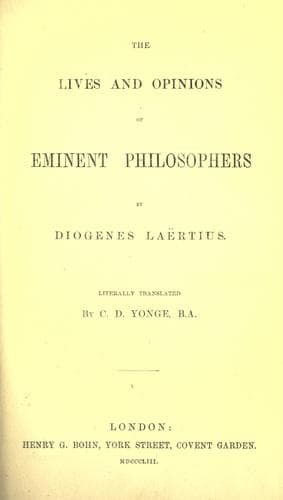
The Lives and Opinions of Eminent PhilosophersDiogenes Laertius
Philosophy
The Lives and Opinions of Eminent Philosophers
Diogenes Laertius
Philosophers, Ancient -- Biography; Philosophy, Ancient
VI. On one occasion, when a sparrow was pursued by a hawk, and flew into
his bosom, he caressed it, and let it go again, saying that we ought
not to betray a suppliant. And being ridiculed by Bion, he said that he
would not answer him, for that tragedy, when ridiculed by comedy, did
not condescend to make a reply. To one who had never learnt music, or
geometry, or astronomy, but who wished to become his disciple, he said,
“Be gone, for you have not yet the handles of philosophy.” But some say
that he said, “Be gone, for I do not card wool here.” And when Dionysius
said to Plato that some one would cut off his head, he, being present,
showed his own, and said, “Not before they have cut off mine.”
VII. They say too that once, when Antipater had come to Athens and
saluted him, he would not make him any reply before he had finished
quietly the discourse which he was delivering.
VIII. Being exceedingly devoid of every kind of pride, he often used to
meditate with himself several times a day; and always allotted one hour
of each day, it is said, to silence.
IX. And he left behind him a great number of writings, and books of
recommendation, and verses, which are these,—six books on Natural
Philosophy; six on Wisdom; one on Riches, the Arcadian; one volume on
the Indefinite; one on a Child; one on Temperance; one on the Useful;
one on the Free; one on Death; one on the Voluntary; two on Friendship;
one on Courtesy; two on Contraries; two on Happiness; one on Writing;
one on Memory; one on Falsehood; the Callicles one; two on Prudence; one
on Œconomy; one on Temperance; one on the Power of Law; one on Political
Constitutions; one on Piety; one to show that Virtue may be transmitted;
one about the Existent; one on Fate; one on the Passions; one on Lives;
one on Unanimity; two on Pupils; one on Justice; two on Virtue; one on
Species; two on Pleasure; one on Life; one on Manly Courage; one on The
One; one on Ideas; one on Art; two on the Gods; two on the Soul; one on
Knowledge; one on the Statesman; one on Science; one on Philosophy; one
on the School of Parmenides; one the Archedemus, or an essay on Justice;
one on the Good; eight of those things which concern the Intellect;
ten essays in solution of the difficulties which occur respecting
Orations; six books on the study of Natural Philosophy; the Principal,
one; one treatise on Genus and Species; one on the doctrines of the
Pythagoreans; two books of Solutions; seven of Divisions; several volumes
of Propositions; several also about the method of conducting Discussions.
Besides all this, there are one set of fifteen volumes, and another of
sixteen, on the subject of those studies which relate to Speaking; nine
more which treat of Ratiocination; six books on Mathematics; two more
books on subjects connected with the Intellect; five books on Geometry;
one book of Reminiscences; one of Contraries; one on Arithmetic; one on
the Contemplation of Numbers; one on Intervals; six on Astronomy; four of
Public-domain text, read in full here on John Shaqi.
Reviews
Reviews
No reviews yet
Be the first to share your thoughts on this work.
Elsewhere in the archive
Join the Discussion
Join the discussion
Sign in to leave a comment or review.
Sign InorCreate an account