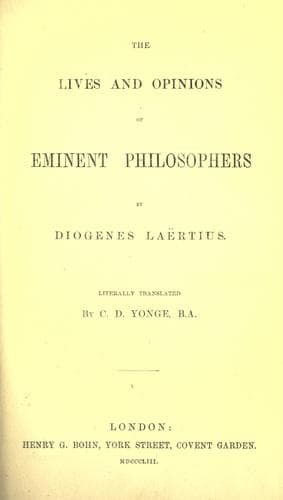
The Lives and Opinions of Eminent PhilosophersDiogenes Laertius
Philosophy
The Lives and Opinions of Eminent Philosophers
Diogenes Laertius
Philosophers, Ancient -- Biography; Philosophy, Ancient
elementary suggestions to Alexander, on the subject of Royal Power; one
addressed to Arybas; one addressed to Hephæstion; two on Geometry; seven
books of Verses.
X. But the Athenians, though he was such a great man, once sold him,
because he was unable to pay the tax to which the metics were liable.
And Demetrius Phalereus purchased him, and so assisted both parties,
Xenocrates by giving him his freedom, and the Athenians in respect of the
tax upon metics. This circumstance is mentioned by Myronianus of Amastra,
in the first book of his chapters of Historical Coincidences.
XI. He succeeded Speusippus, and presided over the school for twenty-five
years, beginning at the archonship of Lysimachides, in the second year of
the hundred and tenth olympiad.
XII. And he died in consequence of stumbling by night against a dish,
being more than eighty-two years of age. And in one of our epigrams we
speak thus of him:—
He struck against a brazen pot,
And cut his forehead deep,
And crying cruel is my lot,
In death he fell asleep.
So thus Xenocrates did fall,
The universal friend of all.
XIII. And there were five other people of the name of Xenocrates. One was
an ancient tactician, a fellow citizen, and very near relation of the
philosopher of whom we have been speaking; and there is extant an oration
of his which is scribed, On Arsinoe, and which was written on the death
of Arsinoe. A third was a philosopher who wrote some very indifferent
elegiac poetry; and that is not strange, for when poets take to writing
in prose, they succeed pretty well; but when prose writers try their hand
at poetry, they fail; from which it is plain, that the one is a gift of
nature, and the other a work of art. The fourth was a statuary; the fifth
a writer of songs, as we are told by Aristoxenus.
LIFE OF POLEMO.
I. Polemo was the son of Philostratus, an Athenian, of the burgh of Œa.
And when he was young, he was so very intemperate and profligate, that
he used always to carry money about with him, to procure the instant
gratification of his passions; and he used also to hide money in the
narrow alleys, for this purpose. And once there was found in the Academy
a piece of three obols, hidden against one of the columns, which he had
put there for some purpose like that which I have indicated; and on one
occasion he arranged beforehand with some young men, and rushed, adorned
with a garland, and drunk, into the school of Xenocrates. But he took no
notice of him, and continued his discourse as he had begun it, and it was
in praise of temperance; and the young man, hearing it, was gradually
charmed, and became so industrious, that he surpassed all the rest of the
disciples, and himself became the successor of Xenocrates, in his school
beginning in the hundred and sixteenth olympiad.
II. And Antigonus, of Carystus, says in his Lives, that his father had
been the chief man of the city, and had kept chariots for the Olympic
games.
Public-domain text, read in full here on John Shaqi.
Reviews
Reviews
No reviews yet
Be the first to share your thoughts on this work.
Elsewhere in the archive
Join the Discussion
Join the discussion
Sign in to leave a comment or review.
Sign InorCreate an account