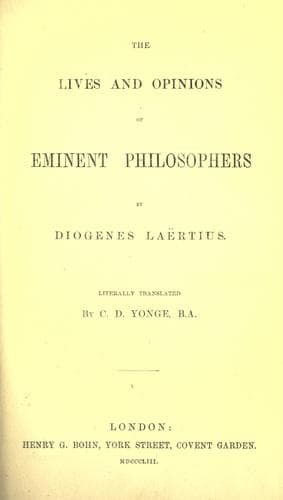
The Lives and Opinions of Eminent PhilosophersDiogenes Laertius
Philosophy
The Lives and Opinions of Eminent Philosophers
Diogenes Laertius
Philosophers, Ancient -- Biography; Philosophy, Ancient
Do you not hear, we’ve buried Polemo,
Whom sickness, worst affliction of mankind
Attacked, and bore off to the shades below;
Yet Polemo lies not here, but Polemo’s body
And that he did himself place here on earth,
Prepared in soul to mount up to the skies.
LIFE OF CRATES.
I. Crates was the son of Antigenes, and of the Thriasian burgh, and
a pupil and attached friend of Polemo. He was also his successor as
president of his school.
II. And they benefited one another so much, that not only did they
delight while alive in the same pursuits, but almost to their latest
breath did they resemble one another, and even after they were both dead
they shared the same tomb. In reference to which circumstance Antagoras
has written an epigram on the pair, in which he expresses himself thus:—
Stranger, who passest by, relate that here
The God-like Crates lies, and Polemo;
Two men of kindred nobleness of mind;
Out of whose holy mouths pure wisdom flowed,
And they with upright lives did well display,
The strength of all their principles and teaching.
And they say too that it was in reference to this that Arcesilaus, when
he came over to them from Theophrastus, said that they were some gods,
or else a remnant of the golden race; for they were not very fond of
courting the people, but had a disposition in accordance with the saying
of Dionysodorus the flute player, who is reported to have said, with
great exultation and pride, that no one had ever heard his music in a
trireme or at a fountain as they had heard Ismenius.
III. Antigonus relates that he used to be a messmate of Crantor, and that
these philosophers and Arcesilaus lived together; and that Arcesilaus
lived in Crantor’s house, but that Polemo and Crates lived in the house
of one of the citizens, named Lysicles; and he says that Crates was,
as I have already mentioned, greatly attached to Polemo, and so was
Arcesilaus to Crantor.
IV. But when Crates died, as Apollodorus relates in the third book of
his Chronicles, he left behind him compositions, some on philosophical
subjects and some on comedy, and some which were speeches addressed to
assemblies of the people, or delivered on the occasion of embassies.
V. He also left behind him some eminent disciples, among whom were
Arcesilaus, about whom we shall speak presently, for he too was a
pupil of his, and Bion of the Borysthenes, who was afterwards called a
Theodorean, from the sect which he espoused, and we shall speak of him
immediately after Arcesilaus.
Public-domain text, read in full here on John Shaqi.
Reviews
Reviews
No reviews yet
Be the first to share your thoughts on this work.
Elsewhere in the archive
Join the Discussion
Join the discussion
Sign in to leave a comment or review.
Sign InorCreate an account