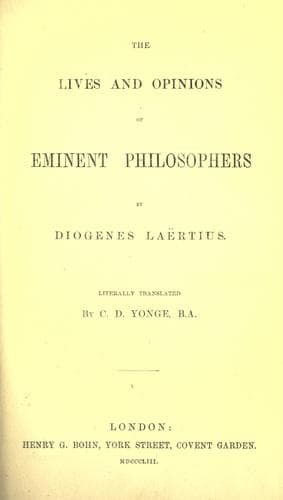
The Lives and Opinions of Eminent PhilosophersDiogenes Laertius
Philosophy
The Lives and Opinions of Eminent Philosophers
Diogenes Laertius
Philosophers, Ancient -- Biography; Philosophy, Ancient
III. He also asserts that Polemo was prosecuted by his wife, on the
charge of ill-treatment, because he indulged in illicit pleasures, and
despised her.
IV. But that when he began to devote himself to philosophy, he adopted
such a rigorous system of morals, that he for the future always continued
the same in appearance, and never even changed his voice, on which
account Crantor was charmed by him. Accordingly, on one occasion, when a
dog was mad and had bitten his leg, he was the only person who did not
turn pale; and once, when there was a great confusion in the city, he,
having heard the cause, remained where he was without fleeing. In the
theatres too he was quite immoveable; accordingly, when Nicostratus the
poet, who was surnamed Clytæmnestra, was once reading something to him
and Crates, the latter was excited to sympathy, he behaved as though he
heard nothing. And altogether, he was such as Melanthius, the painter,
describes in his treatise on Painting; for he says that some kind of
obstinacy and harshness ought to exist in works of art as in morals.
And Polemo used to say that a man ought to exercise himself in action,
and not in dialectic speculations, as if one had drunk in and dwelt
upon a harmonious kind of system of art, so as to be admired for one’s
shrewdness, in putting questions; but to be inconsistent with one’s self
in character. He was, then, a well-bred and high-spirited man, avoiding
what Aristophanes says of Euripides, speeches of vinegar and assafœtida,
such as he says himself:—
Are base delights compared with better things?
V. And he did not use to lecture on the propositions before him while
sitting down; but he would walk about, it is said, and so discuss them.
And he was much honoured in the city because of his noble sentiments;
and after he had been walking about, he would rest in his garden; and
his pupils erected little cabins near it, and dwelt near his school and
corridor.
VI. And as it seems, Polemo imitated Xenocrates in everything; and
Aristippus, in the fourth book of his treatise on Ancient Luxury, says
that Xenocrates loved him; at all events, Polemo used to be always
speaking of him, and praising his guileless nature, and his rigorous
virtues, and his chaste severity, like that of a Doric building.
VII. He was also very fond of Sophocles, and especially of those passages
where, according to one of the comic poets, he seemed to have had a
Molossian hound for his colleague in composing his poems; and when there
was, to use the expression of Phrynichus:—
No sweet or washy liquor, but purest Pramnian wine.
And he used to say that Homer was an epic Sophocles, and Sophocles a
tragic Homer.
VIII. And he died when he was very old, of decline, having left behind
him a great number of writings. And there is this epigram of ours upon
him:—
Public-domain text, read in full here on John Shaqi.
Reviews
Reviews
No reviews yet
Be the first to share your thoughts on this work.
Elsewhere in the archive
Join the Discussion
Join the discussion
Sign in to leave a comment or review.
Sign InorCreate an account