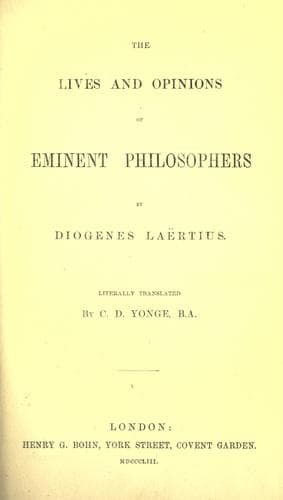
The Lives and Opinions of Eminent PhilosophersDiogenes Laertius
Philosophy
The Lives and Opinions of Eminent Philosophers
Diogenes Laertius
Philosophers, Ancient -- Biography; Philosophy, Ancient
My mind is much perplexed; for what, O Love,
Dare I pronounce your origin? May I
Call you chiefest of the immortal Gods,
Of all the children whom dark Erebus
And Royal Night bore on the billowy waves
Of widest Ocean? Or shall I bid you hail,
As son of proudest Venus? or of Earth?
Or of the untamed winds? so fierce you rove,
Bringing mankind sad cares, yet not unmixed
With happy good, so two-fold is your nature.
And he was very ingenious at devising new words and expressions;
accordingly, he said that one tragedian had an unhewn (ἀπελέκητος) voice,
all over bark; and he said that the verses of a certain poet were full
of moths; and that the propositions of Theophrastus had been written on
an oyster shell. But the work of his which is most admired is his book on
Mourning.
VII. And he died before Polemo and Crates, having been attacked by the
dropsy; and we have written this epigram on him:—
The worst of sicknesses has overwhelmed you,
O Crantor, and you thus did quit the earth,
Descending to the dark abyss of Hell.
Now you are happy there; but all the while
The sad Academy, and your native land
Of Soli mourn, bereaved of your eloquence.
LIFE OF ARCESILAUS.
I. Arcesilaus was the son of Seuthes or Scythes, as Apollodorus states in
the third book of his Chronicles, and a native of Pitane in Æolia.
II. He was the original founder of the Middle Academy, and the first man
who professed to suspend the declaration of his judgment, because of the
contrarieties of the reasons alleged on either side. He was likewise the
first who attempted to argue on both sides of a question, and who also
made the method of discussion, which had been handed down by Plato, by
means of question and answer, more contentious than before.
III. He met with Crantor in the following manner. He was one of four
brothers, two by the same father and two by the same mother. Of those
who were by the same mother the eldest was Pylades, and of those by the
same father the eldest was Mœreas, who was his guardian; and at first he
was a pupil of Autolycus the mathematician, who happened to be a fellow
citizen of his before he went to Athens; and with Autolycus he travelled
as far as Sardis. After that he became a pupil of Xanthus the musician,
and after that attended the lectures of Theophrastus, and subsequently
came over to the Academy to Crantor. For Mœreas his brother, whom I have
mentioned before, urged him to apply himself to rhetoric; but he himself
had a preference for philosophy, and when he became much attached to him
Crantor asked him, quoting a line out of the Andromeda of Euripides:—
O virgin, if I save you, will you thank me?
And he replied by quoting the next line to it:—
O take me to you, stranger, as your slave,
Or wife, or what you please.
Public-domain text, read in full here on John Shaqi.
Reviews
Reviews
No reviews yet
Be the first to share your thoughts on this work.
Elsewhere in the archive
Join the Discussion
Join the discussion
Sign in to leave a comment or review.
Sign InorCreate an account