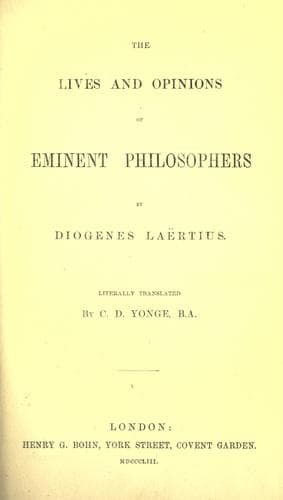
The Lives and Opinions of Eminent PhilosophersDiogenes Laertius
Philosophy
The Lives and Opinions of Eminent Philosophers
Diogenes Laertius
Philosophers, Ancient -- Biography; Philosophy, Ancient
And ever after that they became very intimate, so that they say
Theophrastus was much annoyed, and said, “That a most ingenious and
well-disposed young man had deserted his school.”
IV. For he was not only very impressive in his discourse, and displayed
a great deal of learning in it, but he also tried his hand at poetry,
and there is extant an epigram which is attributed to him, addressed to
Attalus, which is as follows:—
Pergamus is not famed for arms alone,
But often hears its praise resound
For its fine horses, at the holy Pisa.
Yet, if a mortal may declare,
Its fate as hidden in the breast of Jove,
It will be famous for its woes.
There is another addressed to Menodorus the son of Eudamus, who was
attached to one of his fellow pupils:—
Phrygia is a distant land, and so
Is sacred Thyatira, and Cadanade,
Your country Menodorus. But from all,
As the unvaried song of bards relates,
An equal road does lie to Acheron,
That dark unmentioned river; so you lie
Here far from home; and here Eudamus raises
This tomb above your bones, for he did love you,
Though you were poor, with an undying love.
But he admired Homer above all poets, and always used to read a portion
of his works before going to sleep; and in the morning he would say that
he was going to the object of his love, when he was going to read him.
He said, too, that Pindar was a wonderful man for filling the voice, and
pouring forth an abundant variety of words and expressions. He also,
when he was a young man, wrote a criticism on Ion.
V. And he was a pupil likewise of Hipponicus, the geometrican whom
he used to ridicule on other points as being lazy and gaping; but he
admitted that in his own profession he was clear sighted enough, and said
that geometry had flown into his mouth while he was yawning. And when he
went out of his mind, he took him to his own house, and took care of him
till he recovered his senses.
VI. And when Crates died, he succeeded him in the presidency of his
schools, a man of the name of Socrates willingly yielding to him.
VII. And as he suspended his judgment on every point, he never, as it is
said, wrote one single book. But others say that he was once detected
correcting some passages in a work of his; and some assert that he
published it, while others deny it, and affirm that he threw it into the
fire.
VIII. He seems to have been a great admirer of Plato, and he possessed
all his writings. He also, according to some authorities, had a very high
opinion of Pyrrho.
IX. He also studied dialectics, and the discussions of the Eretrian
school; on which account Ariston said of him:—
First Plato comes, and Pyrrho last,
And in the middle Diodorus.
And Timon speaks thus of him:—
For having on this side the heavy load
Of Menedemus plac’d beneath his breast,
He’ll to stout Pyrrho run, or Diodorus.
And presently afterwards he represents him as saying:—
Public-domain text, read in full here on John Shaqi.
Reviews
Reviews
No reviews yet
Be the first to share your thoughts on this work.
Elsewhere in the archive
Join the Discussion
Join the discussion
Sign in to leave a comment or review.
Sign InorCreate an account