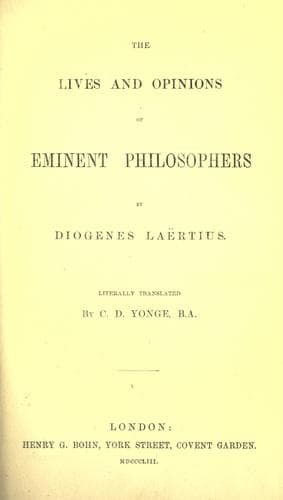
The Lives and Opinions of Eminent PhilosophersDiogenes Laertius
Philosophy
The Lives and Opinions of Eminent Philosophers
Diogenes Laertius
Philosophers, Ancient -- Biography; Philosophy, Ancient
XVII. Demochares the son of Laches, and Pythocles the son of Bugelus,
were also among his friends, and he said that he humoured them in all
their wishes because of his great patience. And, on this account, those
people to whom I have before alluded, used to attack him and ridicule him
as a popularity hunter and vain-glorious man. And they set upon him very
violently at an entertainment given by Hieronymus, the Peripatetic, when
he invited his friends on the birthday of Alcyoneus, the son of Antigonus,
on which occasion Antigonus sent him a large sum of money to promote the
conviviality. On this occasion, as he avoided all discussion during the
continuance of the banquet, when Aridelus proposed to him a question
which required some deliberation, and entreated him to discourse upon it,
it is said that he replied, “But this is more especially the business of
philosophy, to know the proper time for everything.” With reference to
the charge that was brought against him of being a popularity hunter,
Timon speaks, among other matters, mentioning it in the following manner:—
He spoke and glided quick among the crowd,
They gazed on him as finches who behold
An owl among them. You then please the people!
Alas, poor fool, ’tis no great matter that;
Why give yourself such airs for such a trifle?
XVIII. However, in all other respects he was so free from vanity, that
he used to advise his pupils to become the disciples of other men; and
once, when a young man from Chios was not satisfied with his school, but
preferred that of Hieronymus, whom I have mentioned before, he himself
took him and introduced him to that philosopher, recommending him to
preserve his regularity of conduct. And there is a very witty saying of
his recorded. For when some one asked him once, why people left other
schools to go to the Epicureans, but no one left the Epicureans to join
other sects, he replied, “People sometimes make eunuchs of men, but no
one can ever make a man out of an eunuch.”
XIX. At last, when he was near his end, he left all his property to his
brother Pylades, because he, without the knowledge of Mæreas, had taken
him to Chios and had brought him from thence to Athens. He never married
a wife, and never had any children. He made three copies of his will, and
deposited one in Eretria with Amphicritus, and one at Athens with some
of his friends, and the third he sent to his own home to Thaumasias, one
of his relations, entreating him to keep it. And he also wrote him the
following letter:—
ARCESILAUS TO THAUMASIAS.
Public-domain text, read in full here on John Shaqi.
Reviews
Reviews
No reviews yet
Be the first to share your thoughts on this work.
Elsewhere in the archive
Join the Discussion
Join the discussion
Sign in to leave a comment or review.
Sign InorCreate an account