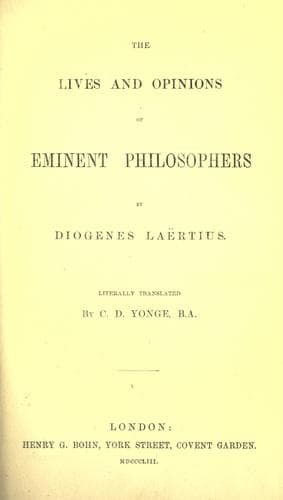
The Lives and Opinions of Eminent PhilosophersDiogenes Laertius
Philosophy
The Lives and Opinions of Eminent Philosophers
Diogenes Laertius
Philosophers, Ancient -- Biography; Philosophy, Ancient
“I have given Diogenes a copy of my will to convey to you. For, because
I am frequently unwell and have got very infirm, I have thought it
right to make a will, that, if anything should happen to me I might not
depart with the feelings of having done you any injury, who have been
so constantly affectionate to me. And as you have been at all times the
most faithful to me of all my friends, I entreat you to preserve this
for me out of regard for my old age and your regard for me. Take care
then to behave justly towards me, remembering how much I entrust to your
integrity, so that I may appear to have managed my affairs well, as far
as depends on you; and there is another copy of this will at Athens, in
the care of some of my friends, and another at Eretria, in the hands of
Amphicritus.”
XX. He died, as Hermippus relates, after having drunk an excessive
quantity of wine, and then became delirious, when he was seventy-five
years old; and he was more beloved by the Athenians than any one else had
ever been. And we have written the following epigram on him:—
O wise Arcesilaus, why didst thou drink
So vast a quantity of unmixed wine,
As to lose all your senses, and then die?
I pity you not so much for your death,
As for the insult that you thus did offer
The Muses, by your sad excess in wine.
XXI. There were also three other persons of the name of Arcesilaus; one a
poet of the old Comedy; another an elegiac poet; the third a sculptor, on
whom Simonides wrote the following epigram:—
This is a statue of chaste Dian’s self
The price two hundred Parian drachmas fine,
Stamp’d with the image of the wanton goat.
It is the work of wise Arcesilaus,
The son of Aristodicus: a man,
Whose hands Minerva guided in his art.
The philosopher of whom we have been speaking flourished, as Apollodorus
tells us in his Chronicles, about the hundred and twentieth olympiad.
LIFE OF BION.
I. Bion was a native of the country around the Borysthenes; but as to who
his parents were, and to what circumstances it was owing that he applied
himself to the study of philosophy, we know no more than what he himself
told Antigonus. For when Antigonus asked him:—
What art thou, say! from whence, from whom you came,
Who are your parents? tell thy race, thy name;[39]
Public-domain text, read in full here on John Shaqi.
Reviews
Reviews
No reviews yet
Be the first to share your thoughts on this work.
Elsewhere in the archive
Join the Discussion
Join the discussion
Sign in to leave a comment or review.
Sign InorCreate an account