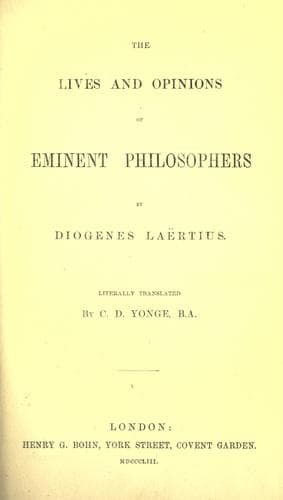
The Lives and Opinions of Eminent PhilosophersDiogenes Laertius
Philosophy
The Lives and Opinions of Eminent Philosophers
Diogenes Laertius
Philosophers, Ancient -- Biography; Philosophy, Ancient
that the way to the shades below was easy; and accordingly, that people
went there with their eyes shut. He used to blame Alcibiades, saying that
while he was a boy he seduced husbands from their wives, and when he had
become a young man he seduced the wives from their husbands. While most
of the Athenians at Rhodes practised rhetoric, he himself used to give
lectures on philosophical subjects; and to one who blamed him for this he
said, “I have bought wheat, and I sell barley.”
It was a saying of his that the inhabitants of the shades below would be
more punished if they carried water in buckets that were whole, than in
such as were bored. To a chattering fellow who was soliciting him for
aid, he said, “I will do what is sufficient for you, if you will send
deputies to me, and forbear to come yourself.” Once when he was at sea
in the company of some wicked men, he fell into the hands of pirates;
and when the rest said, “We are undone, if we are known.” “But I,” said
he, “am undone if we are not known.” He used to say that self-conceit
was the enemy of progress. Of a rich man who was mean and niggardly, he
said, “That man does not possess his estate, but his estate possesses
him.” He used to say that stingy men took care of their property as if
it was their own, but derived no advantage from it as if it belonged to
other people. Another of his sayings was, that young men ought to display
courage, but that old men ought to be distinguished for prudence. And
that prudence was as much superior to the other virtues as sight was
to the other senses. And that it was not right to speak of old age, at
which every one is desirous to arrive. To an envious man who was looking
gloomy, he said, “I know not whether it is because some misfortune has
happened to you, or some good fortune to someone else.” One thing that he
used to say was, that a mean extraction was a bad companion to freedom of
speech. For:—
It does enslave a man, however bold
His speech may be.[41]
And another was that we ought to keep our friends, whatever sort of
people they may be, so that we may not seem to have been intimate with
wicked men, or to have abandoned good men.
IV. Very early in his career he abandoned the school of the Academy, and
at the same time became a disciple of Crates. Then he passed over to the
sect of the Cynics, taking their coarse cloak and wallet. For what else
could ever have changed his nature into one of such apathy? After that he
adopted the Theodorean principles, having become a disciple of Theodorus
the Atheist, who was used to employ every kind of reasoning in support
of his system of philosophy. After leaving him, he became a pupil of
Theophrastus, the Peripatetic.
Public-domain text, read in full here on John Shaqi.
Reviews
Reviews
No reviews yet
Be the first to share your thoughts on this work.
Elsewhere in the archive
Join the Discussion
Join the discussion
Sign in to leave a comment or review.
Sign InorCreate an account