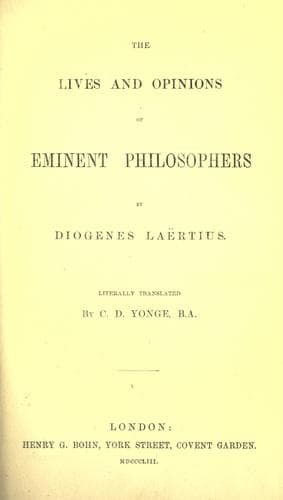
The Lives and Opinions of Eminent PhilosophersDiogenes Laertius
Philosophy
The Lives and Opinions of Eminent Philosophers
Diogenes Laertius
Philosophers, Ancient -- Biography; Philosophy, Ancient
He, knowing that he had been misrepresented to the king, said to him, “My
father was a freedman, who used to wipe his mouth with his sleeve,” (by
which he meant that he used to sell salt fish). “As to his race, he was
a native of the district of the Borysthenes; having no countenance, but
only a brand in his face, a token of the bitter cruelty of his master.
My mother was such a woman as a man of that condition might marry, taken
out of a brothel. Then, my father being in arrears to the tax-gatherers,
was sold with all his family, and with me among them; and as I was young
and good looking, a certain orator purchased me, and when he died he left
me everything. And I, having burnt all his books, and torn up all his
papers, came to Athens and applied myself to the study of Philosophy:—
Such was my father, and from him I came,
The honoured author of my birth and name.[40]
This is all that I can tell you of myself: so that Persæus and Philonides
may give up telling these stories about me: and you may judge of me on my
own merits.”
II. And Bion was truly a man of great versatility, and a very subtle
philosopher, and a man who gave all who chose great opportunities of
practising philosophy. In some respects he was of a gentle disposition,
and very much inclined to indulge in vanity.
III. And he left behind him many memorials of himself in the way of
writings, and also many apophthegms full of useful sentiments. As for
instance, once when he was reproved for having failed to charm a young
man, he replied, “You cannot possibly draw up cheese with a hook before
it has got hard.” On another occasion he was asked who was the most
miserable of men, and replied, “He who has set his heart on the greatest
prosperity.” When he was asked whether it was advisable to marry (for
this answer also is attributed to him), he replied, “If you marry an ugly
woman you will have a punishment (ποινὴ), and if a handsome woman you
will have one who is common” (κοινή). He called old age a port to shelter
one from misfortune; and accordingly, he said that every one fled to it.
He said that glory was the mother of years; that beauty was a good which
concerned others rather than one’s self; that riches were the sinews of
business. To a man who had squandered his estate he said, “The earth
swallowed up Amphiaraus, but you have swallowed up the earth.” Another
saying of his was that it was a great evil not to be able to bear evil.
And he condemned those who burnt the dead as though they felt nothing,
and then mocked them as though they did feel. And he was always saying
that it was better to put one’s own beauty at the disposal of another,
than to covet the beauty of others; for that one who did so was injuring
both his body and his soul. And he used to blame Socrates saying, that if
he derived no advantage from Alcibiades he was foolish, and if he never
derived any advantage from him he then deserved no credit. He used to say
Public-domain text, read in full here on John Shaqi.
Reviews
Reviews
No reviews yet
Be the first to share your thoughts on this work.
Elsewhere in the archive
Join the Discussion
Join the discussion
Sign in to leave a comment or review.
Sign InorCreate an account