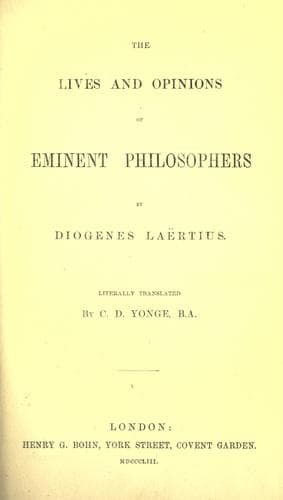
The Lives and Opinions of Eminent PhilosophersDiogenes Laertius
Philosophy
The Lives and Opinions of Eminent Philosophers
Diogenes Laertius
Philosophers, Ancient -- Biography; Philosophy, Ancient
IX. It is said that at night he was not aware when lights were brought
in; and that once he ordered his servant to light the candles, and when
he had brought them in and told him, “I have brought them;” “Well then,”
said he, “read by the light of them.”
X. He had a great many other disciples; but the most eminent of them was
Clitomachus, whom we must mention presently.
XI. There was also another man of the name of Carneades, a very
indifferent elegiac poet.
LIFE OF CLITOMACHUS.
I. Clitomachus was a Carthaginian. He was called Asdrubal, and used to
lecture on philosophy in his own country in his native language.
II. But when he came to Athens, at the age of forty years, he became
a pupil of Carneades; and, as he was pleased with his industry, he
caused him to be instructed in literature, and himself educated the
man carefully. And he carried his diligence to such a degree, that he
composed more than four hundred books.
III. And he succeeded Carneades in his schools; and he illustrated his
principles a great deal by his writings; as he himself had studied the
doctrines of their sects, the Academic, the Peripatetic, and the Stoic.
Timon attacks the whole school of Academics, as a body, in these lines:—
Nor the unprofitable chattering
Of all the Academics.
But now that we have gone through the philosophers of Plato’s school, let
us go to the Peripatetics, who also derived their doctrines from Plato;
and the founder of their sect was Aristotle.
BOOK V.
LIFE OF ARISTOTLE.
I. Aristotle was the son of Nicomachus and Phæstias, a citizen of
Stagira; and Nicomachus was descended from Nicomachus, the son of
Machaon, the son of Æsculapius, as Hermippus tells us in his treatise on
Aristotle; and he lived with Amyntas, the king of the Macedonians, as
both a physician and a friend.
II. He was the most eminent of all the pupils of Plato; he had a lisping
voice, as is asserted by Timotheus the Athenian, in his work on Lives.
He had also very thin legs, they say, and small eyes; but he used to
indulge in very conspicuous dress, and rings, and used to dress his hair
carefully.
III. He had also a son named Nicomachus, by Herpyllis his concubine, as
we are told by Timotheus.
Public-domain text, read in full here on John Shaqi.
Reviews
Reviews
No reviews yet
Be the first to share your thoughts on this work.
Elsewhere in the archive
Join the Discussion
Join the discussion
Sign in to leave a comment or review.
Sign InorCreate an account