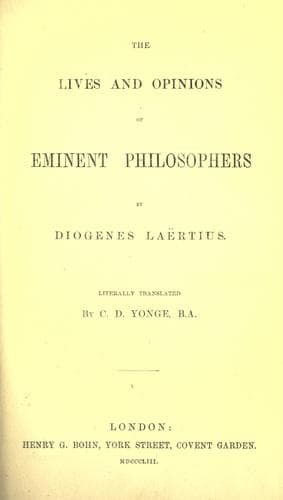
The Lives and Opinions of Eminent PhilosophersDiogenes Laertius
Philosophy
The Lives and Opinions of Eminent Philosophers
Diogenes Laertius
Philosophers, Ancient -- Biography; Philosophy, Ancient
IV. He seceded from Plato while he was still alive; so that they tell
a story that he said, “Aristotle has kicked us off just as chickens do
their mother after they have been hatched.” But Hermippus says in his
Lives, that while he was absent on an embassy to Philip, on behalf of the
Athenians, Xenocrates became the president of the school in the Academy;
and that when he returned and saw the school under the presidency of some
one else, he selected a promenade in the Lyceum, in which he used to walk
up and down with his disciples, discussing subjects of philosophy till
the time for anointing themselves came; on which account he was called
a Peripatetic.[44] But others say that he got this name because once
when Alexander was walking about after recovering from a sickness, he
accompanied him and kept conversing with him. But when his pupils became
numerous, he then gave them seats, saying:—
It would be shame for me to hold my peace,
And for Isocrates to keep on talking.
And he used to accustom his disciples to discuss any question which might
be proposed, training them just as an orator might.
V. After that he went to Hermias the Eunuch, the tyrant of Atarneus, who,
as it is said, allowed him all kinds of liberties; and some say that he
formed a matrimonial connection with him, giving him either his daughter
or his niece in marriage, as is recorded by Demetrius of Magnesia, in his
essay on Poets and Prose-writers of the same name. And the same authority
says that Hermias had been the slave of Eubulus, and a Bithynian by
descent, and that he slew his master. But Aristippus, in the first book
of his treatise on Ancient Luxury, says that Aristotle was enamoured
of the concubine of Hermias, and that, as Hermias gave his consent, he
married her; and was so overjoyed that he sacrificed to her, as the
Athenians do to the Eleusinian Ceres. And he wrote a hymn to Hermias,
which is given at length below.
VI. After that he lived in Macedonia, at the court of Philip, and was
entrusted by him with his son Alexander as a pupil; and he entreated him
to restore his native city which had been destroyed by Philip, and had
his request granted; and he also made laws for the citizens. And also he
used to make laws in his schools, doing this in imitation of Xenocrates,
so that he appointed a president every ten days. And when he thought that
he had spent time enough with Alexander, he departed for Athens, having
recommended to him his relation Callisthenes, a native of Olynthus;
but as he spoke too freely to the king, and would not take Aristotle’s
advice, he reproached him and said:—
Alas! my child, in life’s primeval bloom,
Such hasty words will bring thee to thy doom.[45]
And his prophecy was fulfilled, for as he was believed by Hermolaus to
have been privy to the plot against Alexander, he was shut up in an iron
cage, covered with lice, and untended; and at last he was given to a
lion, and so died.
Public-domain text, read in full here on John Shaqi.
Reviews
Reviews
No reviews yet
Be the first to share your thoughts on this work.
Elsewhere in the archive
Join the Discussion
Join the discussion
Sign in to leave a comment or review.
Sign InorCreate an account