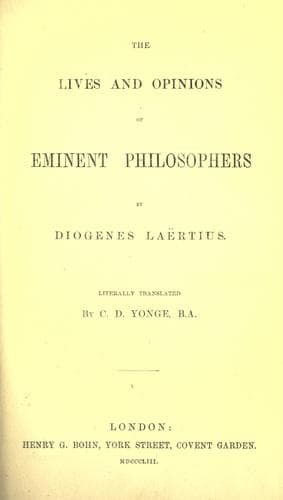
The Lives and Opinions of Eminent PhilosophersDiogenes Laertius
Philosophy
The Lives and Opinions of Eminent Philosophers
Diogenes Laertius
Philosophers, Ancient -- Biography; Philosophy, Ancient
VII. Aristotle then having come to Athens, and having presided over
his school there for thirteen years, retired secretly to Chalcis,
as Eurymedon, the hierophant had impeached him on an indictment for
impiety, though Phavorinus, in his Universal History, says that his
prosecutor was Demophilus, on the ground of having written the hymn to
the beforementioned Hermias, and also the following epigram which was
engraven on his statue at Delphi:—
The tyrant of the Persian archer race,
Broke through the laws of God to slay this man
Not by the manly spear in open fight,
But by the treachery of a faithless friend.
And after that he died of taking a draught of aconite, as Eumelus says
in the fifth book of his Histories, at the age of seventy years. And
the same author says that he was thirty years old when he first became
acquainted with Plato. But this is a mistake of his, for he did only live
in reality sixty-three years, and he was seventeen years old when he
first attached himself to Plato. And the hymn in honour of Hermias is as
follows:—
O Virtue, won by earnest strife,
And holding out the noblest prize
That ever gilded earthly life,
Or drew it on to seek the skies;
For thee what son of Greece would
Deem it an enviable lot,
To live the life, to die the death,
That fears no weary hour, shrinks from no fiery breath?
Such fruit hast thou of heavenly bloom,
A lure more rich than golden heap,
More tempting than the joys of home,
More bland than spell of soft-eyed sleep.
For thee Alcides, son of Jove,
And the twin boys of Leda strove,
With patient toil and sinewy might,
Thy glorious prize to grasp, to reach thy lofty height.
Achilles, Ajax, for thy love
Descended to the realms of night;
Atarneus’ King thy vision drove,
To quit for aye the glad sun-light,
Therefore, to memory’s daughters dear,
His deathless name, his pure career,
Live shrined in song, and link’d with awe,
The awe of Xenian Jove, and faithful friendship’s law.[46]
There is also an epigram of ours upon him, which runs thus:—
Eurymedon, the faithful minister
Of the mysterious Eleusinian Queen,
Was once about t’ impeach the Stagirite
Of impious guilt. But he escaped his hands
By mighty draught of friendly aconite,
And thus defeated all his wicked arts.
Phavorinus, in his Universal History, says that Aristotle was the first
person who ever composed a speech to be delivered in his own defence in a
court of justice, and that he did so on the occasion of this prosecution,
and said that at Athens:—
Pears upon pear-trees grow; on fig-trees, figs.
Public-domain text, read in full here on John Shaqi.
Reviews
Reviews
No reviews yet
Be the first to share your thoughts on this work.
Elsewhere in the archive
Join the Discussion
Join the discussion
Sign in to leave a comment or review.
Sign InorCreate an account