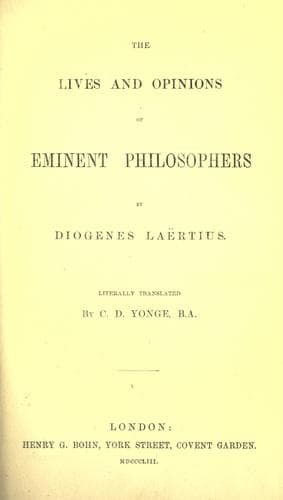
The Lives and Opinions of Eminent PhilosophersDiogenes Laertius
Philosophy
The Lives and Opinions of Eminent Philosophers
Diogenes Laertius
Philosophers, Ancient -- Biography; Philosophy, Ancient
him before for another boy, an additional slave, or a sum of money which
shall be equivalent. I also will that Tychon shall have his liberty when
his daughter is married, and Philon, and Olympius, and his son. Moreover,
of those boys who wait upon me, I will that none shall be sold, but
my executors may use them, and when they are grown up then they shall
emancipate them if they deserve it. I desire too, that my executors will
take under their care the statues which it has been entrusted to Gryllion
to make, that when they are made they may be erected in their proper
places; and so too shall the statues of Nicanor, and of Proxenus, which I
was intending to give him a commission for, and also that of the mother
of Nicanor. I wish them also to erect in its proper place the statue
of Arimnestus which is already made, that it may be a memorial of her,
since she has died childless. I wish them also to dedicate a statue of my
mother to Ceres at Nemea, or wherever else they think fit. And wherever
they bury me, there I desire that they shall also place the bones of
Pythias, having taken them up from the place where they now lie, as she
herself enjoined. And I desire that Nicanor, as he has been preserved,
will perform the vow which I made on his behalf, and dedicate some
figures of animals in stone, four cubits high, to Jupiter the saviour,
and Minerva the saviour, in Stagira.”
These are the provisions of his will.
X. And it is said that a great many dishes were found in his house;
and that Lycon stated that he used to bathe in a bath of warm oil, and
afterwards to sell the oil. But some say that he used to place a leather
bag of warm oil on his stomach. And whenever he went to bed, he used to
take a brazen ball in his hand, having arranged a brazen dish below it;
so that, when the ball fell into the dish, he might be awakened by the
noise.
XI. The following admirable apophthegms are attributed to him.
He was once asked, what those who tell lies gain by it; “They gain this,”
said he, “that when they speak truth they are not believed.”
On one occasion he was blamed for giving alms to a worthless man, and he
replied, “I did not pity the man, but his condition.”
He was accustomed continually to say to his friends and pupils wherever
he happened to be, “That sight receives the light from the air which
surrounds it, and in like manner the soul receives the light from the
science.”
Very often, when he was inveighing against the Athenians, he would say
that they had invented both wheat and laws, but that they used only the
wheat and neglected the laws.
It was a saying of his that the roots of education were bitter, but the
fruit sweet.
Once he was asked what grew old most speedily, and he replied,
“Gratitude.”
On another occasion the question was put to him, what hope is? and his
answer was, “The dream of a waking man.”
Public-domain text, read in full here on John Shaqi.
Reviews
Reviews
No reviews yet
Be the first to share your thoughts on this work.
Elsewhere in the archive
Join the Discussion
Join the discussion
Sign in to leave a comment or review.
Sign InorCreate an account