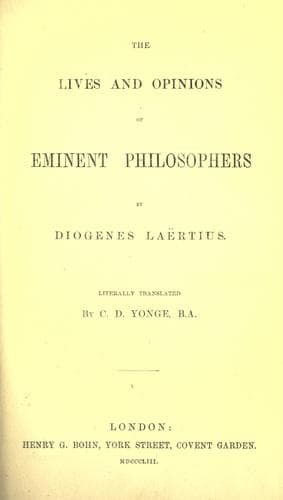
The Lives and Opinions of Eminent PhilosophersDiogenes Laertius
Philosophy
The Lives and Opinions of Eminent Philosophers
Diogenes Laertius
Philosophers, Ancient -- Biography; Philosophy, Ancient
He used to define justice as “A virtue of the soul distributive of what
each person deserved.”
Another of his sayings was, that education was the best viaticum for old
age.
Phavorinus, in the second book of his Commentaries, says that he was
constantly repeating, “The man who has friends has no friend.” And this
sentiment is to be found also in the seventh book of the Ethics.
These apophthegms then are attributed to him.
XII. He also wrote a great number of works; and I have thought it worth
while to give a list of them, on account of the eminence of their author
in every branch of philosophy. Four books on Justice; three books on
Poets; three books on Philosophy; two books of The Statesman; one on
Rhetoric, called also the Gryllus; the Nerinthus, one; the Sophist, one;
the Menexenus, one; the Erotic, one; the Banquet, one; on Riches, one;
the Exhortation, one; on the Soul, one; on Prayer, one; on Nobility of
Birth, one; on Pleasure, one; the Alexander, or an Essay on Colonists,
one; on Sovereignty, one; on Education, one; on the Good, three; three
books on things in the Laws of Plato; two on Political Constitutions;
on Economy, one; on Friendship, one; on Suffering, or having Suffered,
one; on Sciences, one; on Discussions, two; Solutions of Disputed
Points, two; Sophistical Divisions, four; on Contraries, one; on Species
and Genera, one; on Property, one; Epicheirematic, or Argumentative
Commentaries, three; Propositions relating to Virtue, three; Objections,
one; one book on things which are spoken of in various ways, or a
Preliminary Essay; one on the Passion of Anger; five on Ethics; three
on Elements; one on Science; one on Beginning; seventeen on Divisions;
on Divisible Things, one; two books of Questions and Answers; two on
Motion; one book of Propositions; four of Contentious Propositions; one
of Syllogisms; eight of the First Analytics; two of the second greater
Analytics; one on Problems; eight on Method; one on the Better; one on
the Idea; Definitions serving as a preamble to the Topics, seven; two
books more of Syllogisms; one of Syllogisms and Definitions; one on
what is Eligible, and on what is Suitable; the Preface to the Topics,
one; Topics relating to the Definitions, two; one on the Passions; one
on Divisions; one on Mathematics; thirteen books of Definitions; two
of Epicheiremata, or Arguments; one on Pleasure; one of Propositions;
on the Voluntary, one; on the Honourable, one; of Epicheirematic or
Argumentative Propositions, twenty-five books; of Amatory Propositions,
four; of Propositions relating to Friendship, two; of Propositions
relating to the Soul, one; on Politics, two; Political Lectures, such as
that of Theophrastus, eight; on Just Actions, two; two books entitled, A
Collection of Arts; two on the Art of Rhetoric; one on Art; two on other
Art; one on Method; one, the Introduction to the Art of Theodectes; two
books, being a treatise on the Art of Poetry; one book of Rhetorical
Public-domain text, read in full here on John Shaqi.
Reviews
Reviews
No reviews yet
Be the first to share your thoughts on this work.
Elsewhere in the archive
Join the Discussion
Join the discussion
Sign in to leave a comment or review.
Sign InorCreate an account