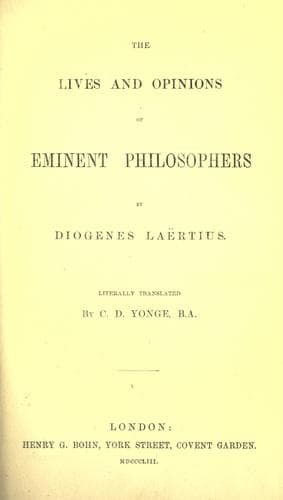
The Lives and Opinions of Eminent PhilosophersDiogenes Laertius
Philosophy
The Lives and Opinions of Eminent Philosophers
Diogenes Laertius
Philosophers, Ancient -- Biography; Philosophy, Ancient
He has also furnished us with a double criterion of truth. One, on the
perception of those effects, which are according to imagination; the
other, the intelligence of those things which are ethical, and which
concern politics, and economy, and laws. The chief good he has defined
to be the exercise of virtue in a perfect life. He used also to say,
that happiness was a thing made up of three kinds of goods. First of
all, the goods of the soul, which he also calls the principal goods in
respect of their power; secondly, the goods of the body, such as health,
strength, beauty, and things of that sort; thirdly, external goods, such
as wealth, nobility of birth, glory, and things like those. And he taught
that virtue was not sufficient of itself to confer happiness; for that
it had need besides of the goods of the body, and of the external goods,
for that a wise man would be miserable if he were surrounded by distress,
and poverty, and circumstances of that kind. But, on the other hand, he
said, that vice was sufficient of itself to cause unhappiness, even if
the goods of the body and the external goods were present in the greatest
possible degree. He also asserted that the virtues did not reciprocally
follow one another, for that it was possible for a prudent, and just,
and impartial man, to be incontinent and intemperate; and he said, that
the wise man was not destitute of passions, but endowed with moderate
passions.
He also used to define friendship as an equality of mutual benevolence.
And he divided it into the friendship of kindred, and of love, and of
those connected by ties of hospitality. And he said, that love was
divided into sensual and philosophical love. And that the wise man would
feel the influence of love, and would occupy himself in affairs of state,
and would marry a wife, and would live with a king. And as there were
three kinds of life, the speculative, the practical, and the voluptuous,
he preferred the speculative. He also considered the acquisition of
general knowledge serviceable to the acquisition of virtue. As a natural
philosopher, he was the most ingenious man that ever lived in tracing
effects back to their causes, so that he could explain the principles of
the most trifling circumstances; on which account he wrote a great many
books of commentaries on physical questions.
Public-domain text, read in full here on John Shaqi.
Reviews
Reviews
No reviews yet
Be the first to share your thoughts on this work.
Elsewhere in the archive
Join the Discussion
Join the discussion
Sign in to leave a comment or review.
Sign InorCreate an account