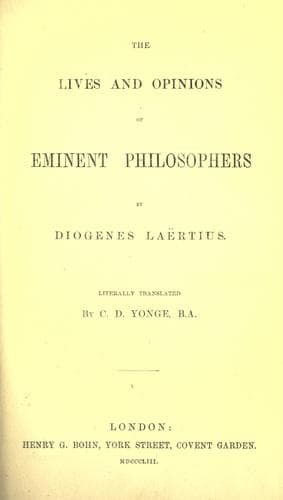
The Lives and Opinions of Eminent PhilosophersDiogenes Laertius
Philosophy
The Lives and Opinions of Eminent Philosophers
Diogenes Laertius
Philosophers, Ancient -- Biography; Philosophy, Ancient
He used to teach that God was incorporeal, as Plato also asserted, and
that his providence extends over all the heavenly bodies; also, that he
is incapable of motion. And that he governs all things upon earth with
reference to their sympathy with the heavenly bodies. Another of his
doctrines was, that besides the four elements there is one other, making
the fifth, of which all the heavenly bodies are composed; and that this
one possesses a motion peculiar to itself, for it is a circular one.
That the soul is incorporeal, being the first ἐντελέχεια; for it is
the ἐντελέχεια of a physical and organic body, having an existence in
consequence of a capacity for existence. And this is, according to him,
of a twofold nature. By the word ἐντελέχεια, he means something which
has an incorporeal species, either in capacity, as a figure of Mercury
in wax, which has a capacity for assuming any shape; or a statue in
brass; and so the perfection of the Mercury or of the statue is called
ἐντελέχεια, with reference to its habit. But when he speaks of the
ἐντελέχεια[47] of a natural body, he does so because, of bodies some are
wrought by the hands, as for instance, those which are made by artists,
for instance, a tower, or a ship; and some exist by nature, as the bodies
of plants and animals. He has also used the term with reference to an
organic body, that is to say, with reference to something that is made,
as the faculty of sight for seeing, or the faculty of hearing for the
purpose of hearing. The capacity of having life must exist in the thing
itself. But the capacity is twofold, either in habit or in operation. In
operation, as a man, when awake, is said to have a soul; in habit, as the
same is said of a man when asleep. That, therefore, he may come under his
definition, he has added the word capacity.
He has also given other definitions on a great many subjects, which it
would be tedious to enumerate here. For he was in every thing a man of
the greatest industry and ingenuity, as is plain from all his works which
I have lately given a list of; which are in number nearly four hundred,
the genuineness of which is undoubted. There are, also, a great many
other works attributed to him, and a number of apophthegms which he never
committed to paper.
XIV. There were eight persons of the name of Aristotle. First of all, the
philosopher of whom we have been speaking; the second was an Athenian
statesman, some of whose forensic orations, of great elegance, are
still extant; the third was a man who wrote a treatise on the Iliad;
the fourth, a Siciliot orator, who wrote a reply to the Panegyric of
Isocrates; the fifth was the man who was surnamed Myth, a friend of
Æschines, the pupil of Socrates; the sixth was a Cyrenean, who wrote a
treatise on Poetry; the seventh was a schoolmaster, who is mentioned by
Aristoxenus in his Life of Plato; the eighth, was an obscure grammarian,
to whom a treatise on Pleonasm is attributed.
Public-domain text, read in full here on John Shaqi.
Reviews
Reviews
No reviews yet
Be the first to share your thoughts on this work.
Elsewhere in the archive
Join the Discussion
Join the discussion
Sign in to leave a comment or review.
Sign InorCreate an account