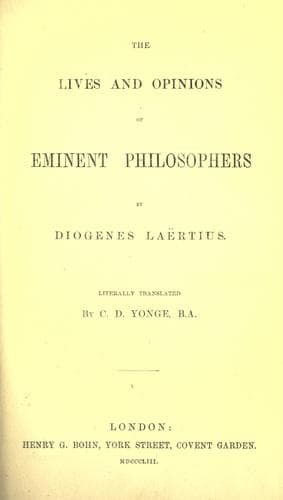
The Lives and Opinions of Eminent PhilosophersDiogenes Laertius
Philosophy
The Lives and Opinions of Eminent Philosophers
Diogenes Laertius
Philosophers, Ancient -- Biography; Philosophy, Ancient
VIII. It is also related that Aristotle used the same expression about
him and Callisthenes, which Plato, as I have previously mentioned,
employed about Xenocrates and Aristotle himself. For he is reported to
have said, since Theophrastus was a man of extraordinary acuteness,
who could both comprehend and explain everything, and as the other was
somewhat slow in his natural character, that Theophrastus required a
bridle, and Callisthenes a spur.
IX. It is said, too, that he had a garden of his own after the death of
Aristotle, by the assistance of Demetrius Phalereus, who was an intimate
friend of his.
X. The following very practical apophthegms of his are quoted. He used
to say that it was better to trust to a horse without a bridle than to a
discourse without arrangement. And once, when a man preserved a strict
silence during the whole of a banquet, he said to him, “If you are an
ignorant man, you are acting wisely; but if you have had any education,
you are behaving like a fool.” And a very favourite expression of his
was, that time was the most valuable thing that a man could spend.
XI. He died when he was of a great age, having lived eighty-five years,
when he had only rested from his labours a short time. And we have
composed the following epigram on him:—
The proverb then is not completely false,
That wisdom’s bow unbent is quickly broken;
While Theophrastus laboured, he kept sound,
When he relaxed, he lost his strength and died.
They say that on one occasion, when dying, he was asked by his disciples
whether he had any charge to give them; and he replied, that he had none
but that they should “remember that life holds out many pleasing deceits
to us by the vanity of glory; for that when we are beginning to live,
then we are dying. There is, therefore, nothing more profitless than
ambition. But may you all be fortunate, and either abandon philosophy
(for it is a great labour), or else cling to it diligently, for then the
credit of it is great; but the vanities of life exceed the advantage of
it. However, it is not requisite for me now to advise you what you should
do; but do you yourselves consider what line of conduct to adopt.” And
when he had said this, as report goes, he expired. And the Athenians
accompanied him to the grave, on foot, with the whole population of the
city, as it is related, honouring the man greatly.
XII. But Phavorinus says, that when he was very old he used to go about
in a litter; and that Hermippus states this, quoting Arcesilaus, the
Pitanæan, and the account which he sent to Lacydes of Cyrene.
XIII. He also left behind him a very great number of works, of which I
have thought it proper to give a list on account of their being full of
every sort of excellence. They are as follows:—
Public-domain text, read in full here on John Shaqi.
Reviews
Reviews
No reviews yet
Be the first to share your thoughts on this work.
Elsewhere in the archive
Join the Discussion
Join the discussion
Sign in to leave a comment or review.
Sign InorCreate an account