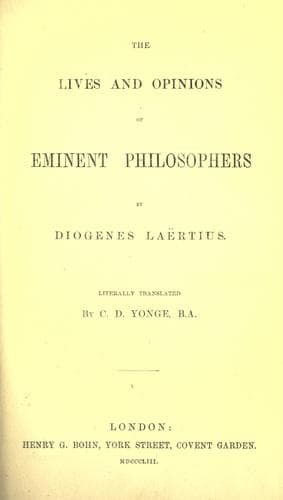
The Lives and Opinions of Eminent PhilosophersDiogenes Laertius
Philosophy
The Lives and Opinions of Eminent Philosophers
Diogenes Laertius
Philosophers, Ancient -- Biography; Philosophy, Ancient
XV. And the Stagirite had many friends, the most eminent of whom was
Theophrastus, whom we must proceed to speak of.
LIFE OF THEOPHRASTUS.
I. Theophrastus was a native of Eresus, the son of Melantas, a fuller,
as we are told by Athenodorus in the eighth book of his Philosophical
Conversations.
II. He was originally a pupil of Leucippus, his fellow citizen, in his
own country; and subsequently, after having attended the lectures of
Plato, he went over to Aristotle. And when he withdrew to Chalcis, he
succeeded him as president of his school, in the hundred and fourteenth
olympiad.
III. It is also said that a slave of his, by name Pomphylus, was a
philosopher, as we are told by Myronianus of Amastra, in the first book
of Similar Historical Chapters.
IV. Theophrastus was a man of great acuteness and industry, and, as
Pamphila asserts in the thirty-second book of her Commentaries, he was
the tutor of Menander, the comic poet. He was also a most benevolent man,
and very affable.
V. Accordingly Cassander received him as a friend; and Ptolemy sent to
invite him to his court. And he was thought so very highly of at Athens,
that when Agonides ventured to impeach him on a charge of impiety, he
was very nearly fined for his hardihood. And there thronged to his school
a crowd of disciples to the number of two thousand. In his letter to
Phanias, the Peripatetic, among other subjects he speaks of the court
of justice in the following terms: “It is not only out of the question
to find an assembly (πανήγυρις), but it is not easy to find even a
company (συνέδριον) such as one would like; but yet recitations produce
corrections of the judgment. And my age does not allow me to put off
everything and to feel indifference on such a subject.” In this letter he
speaks of himself as one who devotes his whole leisure to learning.
And though he was of this disposition, he nevertheless went away for a
short time, both he and all the rest of the philosophers, in consequence
of Sophocles, the son of Amphiclides, having brought forward and carried
a law that no one of the philosophers should preside over a school unless
the council and the people had passed a resolution to sanction their
doing so; if they did, death was to be the penalty. But they returned
again the next year, when Philion had impeached Sophocles for illegal
conduct; when the Athenians abrogated his law, and fined Sophocles five
talents, and voted that the philosophers should have leave to return,
that Theophrastus might return and preside over his school as before.
VI. His name had originally been Tyrtamus, but Aristotle changed it to
Theophrastus, from the divine character of his eloquence.[48]
VII. He is said also to have been very much attached to Aristotle’s son,
Nicomachus, although he was his master; at least, this is stated by
Aristippus in the fourth book of his treatise on the Ancient Luxury.
Public-domain text, read in full here on John Shaqi.
Reviews
Reviews
No reviews yet
Be the first to share your thoughts on this work.
Elsewhere in the archive
Join the Discussion
Join the discussion
Sign in to leave a comment or review.
Sign InorCreate an account