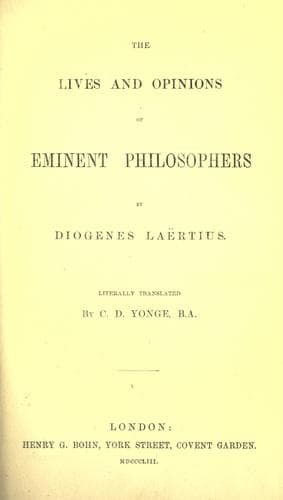
The Lives and Opinions of Eminent PhilosophersDiogenes Laertius
Philosophy
The Lives and Opinions of Eminent Philosophers
Diogenes Laertius
Philosophers, Ancient -- Biography; Philosophy, Ancient
which Strato has entered into with Olympichus and Aminias, which are
preserved in writing in the care of Philocrates, the son of Tisamenus.
And with respect to my monument, let them do whatever seems good to
Arcesilaus, and Olympichus, and Lycon.”
This is his will, which is still extant, as Aristo, the Chian, has
collected and published it.
VIII. And this Strato was a man, as has been shown above, of deservedly
great popularity; having devoted himself to the study of every kind
of philosophy, and especially of that branch of it called natural
philosophy, which is one of the most ancient and important branches of
the whole.
LIFE OF LYCON.
I. He was succeeded by Lycon, a native of the Troas, the son of Astyanax,
a man of great eloquence, and of especial ability in the education of
youth. For he used to say that it was fit for boys to be harnessed with
modesty and rivalry, as much as for horses to be equipped with a spur
and a bridle. And his eloquence and energy in speaking is apparent, from
this instance. For he speaks of a virgin who was poor in the following
manner:—“A damsel, who, for want of a dowry, goes beyond the seasonable
age, is a heavy burden to her father;” on which account they say that
Antigonus said with reference to him, that the sweetness and beauty of an
apple could not be transferred to anything else, but that one might see,
in the case of this man, all these excellencies, in as great perfection
as on a tree; and he said this, because he was a surpassingly sweet
speaker. On which account, some people prefixed a Γ to his name.[50]
But as a writer, he was very unequal to his reputation. And he used to
jest in a careless way, upon those who repented that they had not learnt
when they had the opportunity, and who now wished that they had done so,
saying, said that they were accusing themselves, showing by a prayer
which could not possibly be accomplished, their misplaced repentance for
their idleness. He used also to say, that those who deliberated without
coming to a right conclusion, erred in their calculations, like men who
investigate a correct nature by an incorrect standard, or who look at a
face in disturbed water, or a distorted mirror. Another of his sayings
was, that many men go in pursuit of the crown to be won in the forum, but
few or none seek to attain the one to be gained at the Olympic games.
II. And as he in many instances gave much advice to the Athenians, he was
of exceedingly great service to them.
III. He was also a person of great neatness in his dress, wearing
garments of an unsurpassable delicacy, as we are told by Hermippus.
He was at the same time exceedingly devoted to the exercises of the
Gymnasium, and a man who was always in excellent condition as to his
body, displaying every quality of an athlete (though Antigonus of
Carystus, pretends that he was bruised about the ears and dirty); and in
his own country he is said to have wrestled and played at ball at the
Iliæan games.
Public-domain text, read in full here on John Shaqi.
Reviews
Reviews
No reviews yet
Be the first to share your thoughts on this work.
Elsewhere in the archive
Join the Discussion
Join the discussion
Sign in to leave a comment or review.
Sign InorCreate an account