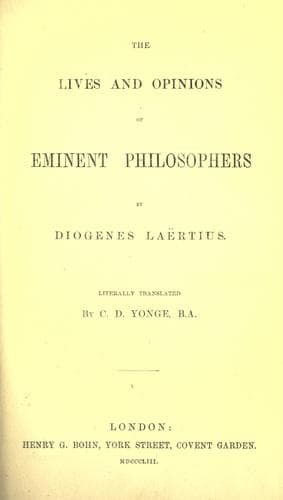
The Lives and Opinions of Eminent PhilosophersDiogenes Laertius
Philosophy
The Lives and Opinions of Eminent Philosophers
Diogenes Laertius
Philosophers, Ancient -- Biography; Philosophy, Ancient
VIII. He was held in the greatest honour among the Athenians, but
nevertheless, he found his fame darkened by envy, which attacks every
thing; for he was impeached by some one on a capital charge, and as
he did not appear, he was condemned. His accusers, however, did not
become masters of his person, but expended their venom on the brass,
tearing down his statues and selling some and throwing others into the
sea, and some they cut up into chamber-pots. For even this is stated.
And one statue alone of him is preserved which is in the Acropolis.
But Phavorinus in his Universal History, says that the Athenians
treated Demetrius in this manner at the command of the king; and they
also impeached him as guilty of illegality in his administration, as
Phavorinus says. But Hermippus says, that after the death of Cassander,
he feared the enmity of Antigonus, and on that account fled to Ptolemy
Soter; and that he remained at his court for a long time, and, among
other pieces of advice, counselled the king to make over the kingdom to
his sons by Eurydice. And as he would not agree to this measure, but gave
the crown to his son by Berenice, this latter, after the death of his
father, commanded Demetrius to be kept in prison until he should come to
some determination about him. And there he remained in great despondency;
and while asleep on one occasion, he was bitten by an asp in the hand,
and so he died. And he is buried in the district of Busiris, near
Diospolis, and we have written the following epigram on him:—
An asp, whose tooth of venom dire was full,
Did kill the wise Demetrius.
The serpent beamed not light from out his eyes,
But dark and lurid hell.
But Heraclides, in his Epitome of the Successions of Sotion, says
that Ptolemy wished to transmit the kingdom to Philadelphus, and that
Demetrius dissuaded him from doing so by the argument, “If you give
it to another, you will not have it yourself.” And when Menander, the
comic poet, had an information laid against him at Athens (for this is
a statement which I have heard), he was very nearly convicted, for no
other reason but that he was a friend of Demetrius. He was, however,
successfully defended by Telesphorus, the son-in-law of Demetrius.
Public-domain text, read in full here on John Shaqi.
Reviews
Reviews
No reviews yet
Be the first to share your thoughts on this work.
Elsewhere in the archive
Join the Discussion
Join the discussion
Sign in to leave a comment or review.
Sign InorCreate an account