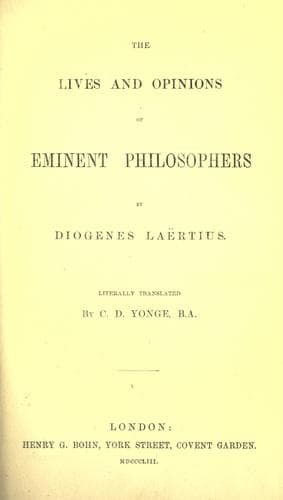
The Lives and Opinions of Eminent PhilosophersDiogenes Laertius
Philosophy
The Lives and Opinions of Eminent Philosophers
Diogenes Laertius
Philosophers, Ancient -- Biography; Philosophy, Ancient
IX. In the multitude of his writings and the number of lines which they
amount to, he exceeded nearly all the Peripatetics of his day, being a
man of great learning and experience on every subject. And some of his
writings are historical, some political, some on poets, some rhetorical,
some also are speeches delivered in public assemblies or on embassies;
there are also collections of Æsop’s Fables, and many other books. There
are five volumes on the Legislation of Athens; two on Citizens of Athens;
two on the Management of the People; two on Political Science; one on
Laws; two on Rhetoric; two on Military Affairs; two on the Iliad; four on
the Odyssey; one called the Ptolemy; one on Love; the Phædondas, one; the
Mædon, one; the Cleon, one; the Socrates, one; the Artaxerxes, one; the
Homeric, one; the Aristides, one; the Aristomachus, one; the Exhortatory,
one; one on the Constitution; one on his Ten Years’ Government; one on
the Ionians; one on Ambassadors; one on Good Faith; one on Gratitude; one
on Futurity; one on Greatness of Soul; one on Marriage; one on Opinion;
one on Peace; one on Laws; one on Studies; one on Opportunity; the
Dionysius, one; the Chalcidean, one; the Maxims of the Athenians, one;
on Antiphanes, one; a Historic Preface, one; one Volume of Letters; one
called an Assembly on Oath; one on Old Age; one on Justice; one volume of
Æsop’s Fables; one of Apophthegms. His style is philosophical, combined
with the energy and impressiveness of an orator.
X. When he was told that the Athenians had thrown down his statues, he
said, “But they have not thrown down my virtues, on account of which they
erected them.” He used to say that the eyebrows were not an insignificant
part of a man, for that they were able to overshadow the whole life.
Another of his sayings was that it was not Plutus alone who was blind,
but Fortune also, who acted as his guide. Another, that reason had as
much influence on government, as steel had in war. On one occasion, when
he saw a debauched young man, he said, “There is a square Mercury with a
long robe, a belly, and a beard.” It was a favourite saying of his, that
in the case of men elated with pride one ought to cut something off their
height, and leave them their spirit. Another of his apophthegms was, that
at home young men ought to show respect to their parents, and in the
streets to every one whom they met, and in solitary places to themselves.
Another, that friends ought to come to others in good fortune only when
invited, but to those in distress of their own accord.
These are the chief sayings attributed to him.
Public-domain text, read in full here on John Shaqi.
Reviews
Reviews
No reviews yet
Be the first to share your thoughts on this work.
Elsewhere in the archive
Join the Discussion
Join the discussion
Sign in to leave a comment or review.
Sign InorCreate an account