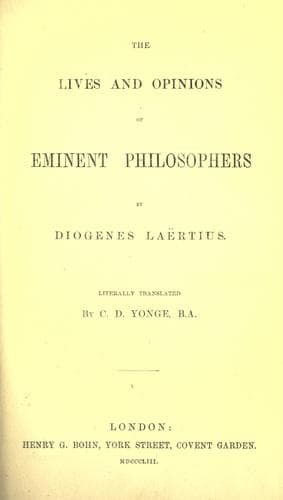
The Lives and Opinions of Eminent PhilosophersDiogenes Laertius
Philosophy
The Lives and Opinions of Eminent Philosophers
Diogenes Laertius
Philosophers, Ancient -- Biography; Philosophy, Ancient
XI. There were twenty persons of the name of Demetrius, of sufficient
consideration to be entitled to mention. First, a Chalcedonian, an
orator, older than Thrasymachus; the second, this person of whom we are
speaking; the third was a Byzantine, a Peripatetic philosopher; the
fourth was a man surnamed Graphicus, a very eloquent lecturer, and also
a painter; the fifth was a native of Aspendus, a disciple of Apollonius,
of Soli; the sixth was a native of Calatia, who wrote twenty books about
Asia and Europe; the seventh was a Byzantine, who wrote an account of
the crossing of the Gauls from Europe into Asia, in thirteen books, and
the History of Antiochus and Ptolemy, and their Administration of the
Affairs of Africa, in eight more; the eighth was a Sophist who lived
in Alexandria, and who wrote a treatise on Rhetorical Art; the ninth
was a native of Adramyttium, a grammarian, who was nick-named Ixion,
in allusion to some crime he had committed against Juno; the tenth
was a Cyrenean, a grammarian, who was surnamed Stamnus,[51] a very
distinguished man; the eleventh was a Scepsian, a rich man of noble
birth, and of great eminence for learning. He it was who advanced the
fortunes of Metrodorus his fellow citizen; the twelfth was a grammarian
of Erythræ, who was made a citizen of Lemnos; the thirteenth was a
Bithynian, a son of Diphilus the Stoic, and a disciple of Panætius of
Rhodes; the fourteenth was an orator of Smyrna. All of these were prose
writers.
The following were poets:—The first a poet of the Old Comedy. The second
an Epic poet, who has left nothing behind him that has come down to us,
except these lines which he wrote against some envious people:—
They disregard a man while still alive,
Whom, when he’s dead, they honour; cities proud,
And powerful nations, have with contest fierce,
Fought o’er a tomb and unsubstantial shade
The third was a native of Tarsus; a writer of Satires. The fourth was
a composer of Iambics, a bitter man. The fifth was a statuary, who
is mentioned by Polemo. The sixth was a native of Erythræ, a man who
wrote on various subjects, and who composed volumes of histories and
relations.[52]
LIFE OF HERACLIDES.
I. Heraclides was the son of Euthyphron, and was born at Heraclea, in
Pontus; he was also a wealthy man.
II. After he came to Athens, he was at first a disciple of Speusippus,
but he also attended the schools of the Pythagorean philosophers, and
he adopted the principles of Plato; last of all he became a pupil of
Aristotle, as we are told by Sotion in his book entitled the Successions.
III. He used to wear delicate garments, and was a man of great size, so
that he was nicknamed by the Athenians Pompicus[53] instead of Ponticus.
But he was of quiet manners and noble aspect.
Public-domain text, read in full here on John Shaqi.
Reviews
Reviews
No reviews yet
Be the first to share your thoughts on this work.
Elsewhere in the archive
Join the Discussion
Join the discussion
Sign in to leave a comment or review.
Sign InorCreate an account