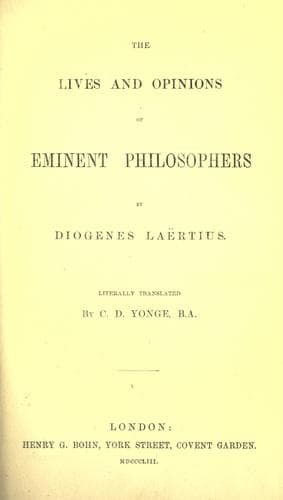
The Lives and Opinions of Eminent PhilosophersDiogenes Laertius
Philosophy
The Lives and Opinions of Eminent Philosophers
Diogenes Laertius
Philosophers, Ancient -- Biography; Philosophy, Ancient
VII. And Aristoxenus the musician says, that he composed tragedies,
and inscribed them with the name of Thespis. And Chamæleon says, that
he stole essays from him on the subject of Homer and Hesiod, and
published them as his own. And Autodorus the Epicurean reproaches him,
and contradicts all the arguments which he advanced in his treatise
on Justice. Moreover, Dionysius, called the Deserter, or as some say
Spintharus, wrote a tragedy called Parthenopæus, and forged the name
of Sophocles to it. And Heraclides was so much deceived that he took
some passages out of one of his works, and cited them as the words of
Sophocles; and Dionysius, when he perceived it, gave him notice of the
real truth; and as he would not believe it, and denied it, he sent him
word to examine the first letters of the first verses of the book, and
they formed the name of Pancalus, who was a friend of Dionysius. And as
Heraclides still refused to believe it, and said that it was possible
that such a thing might happen by chance, Dionysius sent him back word
once more, “You will find this passage too:—
“An aged monkey is not easily caught;
He’s caught indeed, but only after a time.”
And he added, “Heraclides knows nothing of letters, and has no shame.”
VIII. And there were fourteen persons of the name of Heraclides. First,
this man of whom we are speaking; the second was a fellow citizen of his,
who composed songs for Pyrrhic dances, and other trifles; the third was
a native of Cumæ, who wrote a history of the Persian war in five books;
the fourth was also a citizen of Cumæ, who was an orator, and wrote a
treatise on his art; the fifth was a native of Calatia or Alexandria,
who wrote a Succession in six books, and a treatise on Ships, from which
he was called Lembos; the sixth was an Alexandrian, who wrote an account
of the peculiar habits of the Persians; the seventh was a dialectician
of Bargyleia, who wrote against Epicurus; the eighth was a physician, a
pupil of Hicesius; the ninth was a physician of Tarentum, a man of great
skill; the tenth was a poet, who wrote Precepts; the eleventh was a
sculptor of Phocæa; the twelfth was an Epigrammatic poet of considerable
beauty; the thirteenth was a Magnesian, who wrote a history of the reign
of Mithridates; the fourteenth was an astronomer, who wrote a treatise on
Astronomy.
BOOK VI.
LIFE OF ANTISTHENES.
Public-domain text, read in full here on John Shaqi.
Reviews
Reviews
No reviews yet
Be the first to share your thoughts on this work.
Elsewhere in the archive
Join the Discussion
Join the discussion
Sign in to leave a comment or review.
Sign InorCreate an account