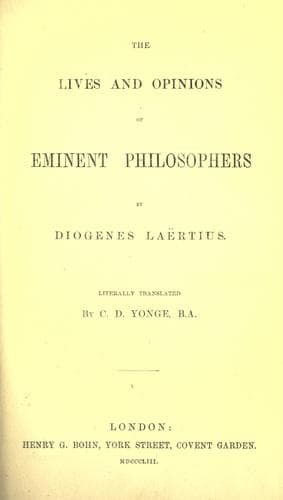
The Lives and Opinions of Eminent PhilosophersDiogenes Laertius
Philosophy
The Lives and Opinions of Eminent Philosophers
Diogenes Laertius
Philosophers, Ancient -- Biography; Philosophy, Ancient
A man said to him one day, “Many people praise you.” “Why, what evil,”
said he, “have I done?” When he turned the rent in his cloak outside,
Socrates seeing it, said to him, “I see your vanity through the hole in
your cloak.” On another occasion, the question was put to him by some
one, as Phanias relates, in his treatise on the Philosophers of the
Socratic school, what a man could do to show himself an honourable and
a virtuous man; and he replied, “If you attend to those who understand
the subject, and learn from them that you ought to shun the bad habits
which you have.” Some one was praising luxury in his hearing, and he
said, “May the children of my enemies be luxurious.” Seeing a young man
place himself in a carefully studied attitude before a modeller, he said,
“Tell me, if the brass could speak, on what would it pride itself?” And
when the young man replied, “On its beauty.” “Are you not then,” said he,
“ashamed to rejoice in the same thing as an inanimate piece of brass?”
A young man from Pontus once promised to recollect him, if a vessel of
salt fish arrived; and so he took him with him, and also an empty bag,
and went to a woman who sold meal, and filled his sack and went away; and
when the woman asked him to pay for it, he said, “The young man will pay
you, when the vessel of salt fish comes home.”
He it was who appears to have been the cause of Anytus’s banishment, and
of Meletus’s death. For having met with some young men of Pontus, who
had come to Athens, on account of the reputation of Socrates, he took
them to Anytus, telling them, that in moral philosophy he was wiser than
Socrates; and they who stood by were indignant at this, and drove him
away. And whenever he saw a woman beautifully adorned, he would go off
to her house, and desire her husband to bring forth his horse and his
arms; and then if he had such things, he would give him leave to indulge
in luxury, for that he had the means of defending himself; but if he had
them not, then he would bid him strip his wife of her ornaments.
Public-domain text, read in full here on John Shaqi.
Reviews
Reviews
No reviews yet
Be the first to share your thoughts on this work.
Elsewhere in the archive
Join the Discussion
Join the discussion
Sign in to leave a comment or review.
Sign InorCreate an account