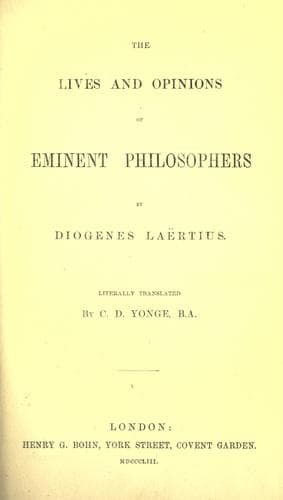
The Lives and Opinions of Eminent PhilosophersDiogenes Laertius
Philosophy
The Lives and Opinions of Eminent Philosophers
Diogenes Laertius
Philosophers, Ancient -- Biography; Philosophy, Ancient
V. And the doctrines he adopted were these. He used to insist that
virtue was a thing which might be taught; also, that the nobly born and
virtuously disposed, were the same people; for that virtue was of itself
sufficient for happiness, and was in need of nothing, except the strength
of Socrates. He also looked upon virtue as a species of work, not wanting
many arguments, or much instruction; and he taught that the wise man was
sufficient for himself; for that everything that belonged to any one
else belonged to him. He considered obscurity of fame a good thing, and
equally good with labour. And he used to say that the wise man would
regulate his conduct as a citizen, not according to the established laws
of the state, but according to the law of virtue. And that he would marry
for the sake of having children, selecting the most beautiful woman for
his wife. And that he would love her; for that the wise man alone knew
what objects deserved love.
Diocles also attributes the following apophthegms to him. To the wise
man, nothing is strange and nothing remote. The virtuous man is worthy
to be loved. Good men are friends. It is right to make the brave and
just one’s allies. Virtue is a weapon of which a man cannot be deprived.
It is better to fight with a few good men against all the wicked, than
with many wicked men against a few good men. One should attend to one’s
enemies, for they are the first persons to detect one’s errors. One
should consider a just man as of more value than a relation. Virtue is
the same in a man as in a woman. What is good is honourable, and what is
bad is disgraceful. Think everything that is wicked, foreign. Prudence
is the safest fortification; for it can neither fall to pieces nor be
betrayed. One must prepare one’s self a fortress in one’s own impregnable
thoughts.
VI. He used to lecture in the Gymnasium called Cynosarges, not far from
the gates; and some people say that it is from that place that the sect
got the name of Cynics. And he himself was called Haplocyon (downright
dog).
VII. He was the first person to set the fashion of doubling his cloak,
as Diocles says, and he wore no other garment. And he used to carry a
stick and a wallet; but Neanthes says that he was the first person who
wore a cloak without folding it. But Sosicrates, in the third book of his
Successions, says that Diodorus, of Aspendos, let his beard grow, and
used to carry a stick and a wallet.
VIII. He is the only one of all the pupils of Socrates, whom Theopompus
praises and speaks of as clever, and able to persuade whomsoever he
pleased by the sweetness of his conversation. And this is plain, both
from his own writings, and from the Banquet of Xenophon. He appears to
have been the founder of the more manly Stoic school; on which account
Athenæus, the epigrammatist, speaks thus of them:—
Public-domain text, read in full here on John Shaqi.
Reviews
Reviews
No reviews yet
Be the first to share your thoughts on this work.
Elsewhere in the archive
Join the Discussion
Join the discussion
Sign in to leave a comment or review.
Sign InorCreate an account