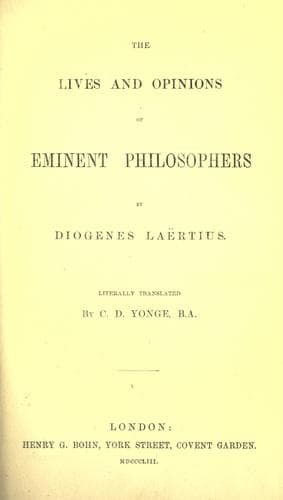
The Lives and Opinions of Eminent PhilosophersDiogenes Laertius
Philosophy
The Lives and Opinions of Eminent Philosophers
Diogenes Laertius
Philosophers, Ancient -- Biography; Philosophy, Ancient
The sixth volume is that in which there is the treatise Truth; another (a
disputatious one) concerning Arguing; the Sathon, or on Contradiction,
in three parts; and an essay on Dialect. The seventh contains a treatise
on Education, or Names, in five books; one on the Use of Names, or
the Contentious Man; one on Questions and Answers; one on Opinion and
Knowledge, in four books; one on Dying; one on Life and Death; one on
those who are in the Shades below; one on Nature, in two books; two
books of Questions in Natural Philosophy; one essay, called Opinions on
the Contentious Man; one book of Problems, on the subject of Learning.
The eighth volume is that in which we find a treatise on Music; one on
Interpreters; one on Homer; one on Injustice and Impiety; one on Calchas;
one on a Spy; one on Pleasure. The ninth book contains an essay on the
Odyssey; one on the Magic Wand; the Minerva, or an essay on Telemachus;
an essay on Helen and Penelope; one on Proteus; the Cyclops, being an
essay on Ulysses; an essay on the Use of Wine, or on Drunkenness, or
on the Cyclops; one on Circe; one on Amphiaraus; one on Ulysses and
Penelope, and also on Ulysses’ Dog. The tenth volume is occupied by
the Heracles, or Medas; the Hercules, or an Essay on Prudence or
Strength; the Lord or the Lover; the Lord or the Spies; the Menexenus,
or an essay on Governing; the Alcibiades; the Archelaus, or an essay on
Kingly Power.
These then are the names of his works. And Timon, rebuking him because of
their great number, called him a universal chatterer.
X. He died of some disease; and while he was ill Diogenes came to visit
him, and said to him, “Have you no need of a friend?” Once too he came
to see him with a sword in his hand; and when Antisthenes said, “Who can
deliver me from this suffering?” he, pointing to the sword, said, “This
can;” But he rejoined, “I said from suffering, but not from life;” for
he seemed to bear his disease the more calmly from his love of life. And
there is an epigram on him written by ourselves, which runs thus:—
In life you were a bitter dog, Antisthenes,
Born to bite people’s minds with sayings sharp,
Not with your actual teeth. Now you are slain
By fell consumption, passers by may say,
Why should he not, one wants a guide to Hell.
There were also three other people of the name of Antisthenes. One, a
disciple of Heraclitus; the second, an Ephesian; the third, a historian
of Rhodes. And since we have spoken of those who proceeded from the
school of Aristippus and Phædon, we may now go on to the Cynics and
Stoics, who derived their origin from Antisthenes. And we will take them
in the following order.
LIFE OF DIOGENES.
Public-domain text, read in full here on John Shaqi.
Reviews
Reviews
No reviews yet
Be the first to share your thoughts on this work.
Elsewhere in the archive
Join the Discussion
Join the discussion
Sign in to leave a comment or review.
Sign InorCreate an account