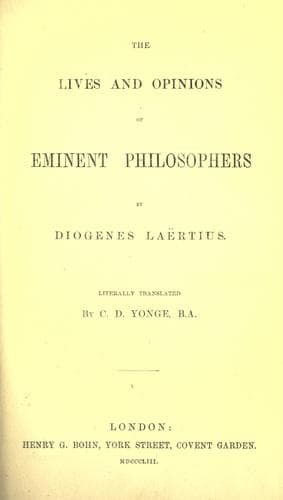
The Lives and Opinions of Eminent PhilosophersDiogenes Laertius
Philosophy
The Lives and Opinions of Eminent Philosophers
Diogenes Laertius
Philosophers, Ancient -- Biography; Philosophy, Ancient
I. Diogenes was a native of Sinope, the son of Hicesius, a money-changer.
And Diocles says that he was forced to flee from his native city, as his
father kept the public bank there, and had adulterated the coinage. But
Eubulides, in his essay on Diogenes, says, that it was Diogenes himself
who did this, and that he was banished with his father. And, indeed,
he himself, in his Pordalus, says of himself that he had adulterated
the public money. Others say that he was one of the curators, and was
persuaded by the artisans employed, and that he went to Delphi, or else
to the oracle at Delos, and there consulted Apollo as to whether he
should do what people were trying to persuade him to do; and that, as the
God gave him permission to do so, Diogenes, not comprehending that the
God meant that he might change the political customs[56] of his country
if he could, adulterated the coinage; and being detected, was banished,
as some people say, but as other accounts have it, took the alarm and
fled away of his own accord. Some again, say that he adulterated the
money which he had received from his father; and that his father was
thrown into prison and died there; but that Diogenes escaped and went
to Delphi, and asked, not whether he might tamper with the coinage, but
what he could do to become very celebrated, and that in consequence he
received the oracular answer which I have mentioned.
II. And when he came to Athens he attached himself to Antisthenes; but as
he repelled him, because he admitted no one; he at last forced his way
to him by his pertinacity. And once, when he raised his stick at him,
he put his head under it, and said, “Strike, for you will not find any
stick hard enough to drive me away as long as you continue to speak.” And
from this time forth he was one of his pupils; and being an exile, he
naturally betook himself to a simple mode of life.
III. And when, as Theophrastus tells us, in his Megaric Philosopher, he
saw a mouse running about and not seeking for a bed, nor taking care
to keep in the dark, nor looking for any of those things which appear
enjoyable to such an animal, he found a remedy for his own poverty.
He was, according to the account of some people, the first person who
doubled up his cloak out of necessity, and who slept in it; and who
carried a wallet, in which he kept his food; and who used whatever place
was near for all sorts of purposes, eating, and sleeping, and conversing
in it. In reference to which habit he used to say, pointing to the
Colonnade of Jupiter, and to the Public Magazine, “that the Athenians had
built him places to live in.” Being attacked with illness, he supported
himself with a staff; and after that he carried it continually, not
indeed in the city, but whenever he was walking in the roads, together
with his wallet, as Olympiodorus, the chief man of the Athenians tells
us; and Polyeuctus, the orator, and Lysanias, the son of Æschrion, tell
the same story.
Public-domain text, read in full here on John Shaqi.
Reviews
Reviews
No reviews yet
Be the first to share your thoughts on this work.
Elsewhere in the archive
Join the Discussion
Join the discussion
Sign in to leave a comment or review.
Sign InorCreate an account